Key takeaways
- Pick one total for the season first, then split it, not the other way around.
- Gifts are only part of it: give food, travel, decorations and hosting their own lines too.
- Divide the total by the months left and save it ahead, so December is spent from money you already have.
- Track as you shop, and when one line runs over, move money from another line instead of adding to the total.
The holidays are one of the few big expenses that arrive on exactly the same date every year, and still catch people off guard. The gifts, the travel, the extra groceries and the small things all land in the same few weeks, often on top of normal bills.
It adds up. In the National Retail Federation’s 2025 holiday survey, consumers said they planned to spend $890.49 per person on average on gifts, food, decorations and other seasonal items.1 Your number may be much higher or lower. What matters is choosing it on purpose, ahead of time, and having the money set aside before December starts.
This guide shows how to set a holiday budget, split it into parts you can manage, save for it in advance, and keep it on track while you shop.
Step 1: Choose one number for the whole season
Most holiday overspending starts with a list and no total. You write down names, pick a gift for each, and add it up afterward. The total is whatever it turns out to be.
Flip it around. Start with the total you can afford, then fit the list inside it.
To find that total:
- Look at what you can set aside each month between now and the holidays after your bills, everyday spending and regular savings.
- Multiply by the months left. In late September, that’s roughly three months.
- Add anything already saved for the holidays.
Example: You can set aside $250 a month from October through December, and you have $150 saved. Your holiday budget is $900. Not what you spent last year, not what feels generous enough. $900.
If that number feels small, that’s useful information. It’s far better to know it in October than to discover it in January.
Step 2: Split it into the real parts of the holidays
Gifts get the attention, but they’re rarely the whole cost. A realistic holiday budget has several lines:
- Gifts. Family, friends, kids’ teachers, coworkers, gift exchanges.
- Food and hosting. The big meal, extra groceries, drinks, baking, a party.
- Travel. Flights, gas, a hotel, pet boarding.
- Decorations. A tree, lights, replacing what broke last year.
- Cards and wrapping. Cards, stamps, paper, tape, bags.
- Shipping. Sending gifts to people who live far away.
- Giving. Donations, tips for service workers, holiday collections.
- Going out. Events, a show, holiday outings with friends.
Example: A $900 holiday budget split across the season.
| Line | Amount |
|---|---|
| Gifts | $450 |
| Food and hosting | $180 |
| Travel (gas for a drive home) | $90 |
| Decorations | $40 |
| Cards, wrapping and shipping | $50 |
| Giving and tips | $50 |
| Cushion for the unexpected | $40 |
| Total | $900 |
The cushion line matters. Something will cost more than you planned, and a small buffer inside the budget keeps that from breaking the total.
Step 3: Build the gift list inside the gift line
With a gift total set, the list has a limit to fit within.
- List everyone you plan to buy for.
- Group them into tiers. A few close people get more, everyone else gets a set, smaller amount.
- Divide the gift line across the tiers until it adds up exactly.
Example: A $450 gift line.
| Tier | People | Per person | Subtotal |
|---|---|---|---|
| Partner and kids | 3 | $80 | $240 |
| Parents and siblings | 5 | $30 | $150 |
| Teachers, coworkers, exchange | 4 | $15 | $60 |
| Total | 12 | $450 |
If the list doesn’t fit, you have options that don’t involve a bigger total: a family gift exchange instead of buying for everyone, one shared gift for a household, or something homemade.
Step 4: Save for it ahead of time
A holiday budget works best when it’s saved before it’s spent. Divide what’s still needed by the months left, and set that aside every month.
| Start saving in | Months until mid-December | Monthly amount for $900 |
|---|---|---|
| January | 11 | about $82 |
| June | 6 | $150 |
| September | 3 to 4 | $225 to $300 |
| November | 1 to 2 | $450 to $900 |
The earlier you start, the smaller the monthly amount. This is the same idea as a sinking fund, a small monthly amount for a cost you know is coming. Sinking funds for annual expenses explains the method, which works just as well for the holidays as for car insurance.
Keep the holiday money somewhere it won’t mix with everyday spending, like a separate savings account you name for the holidays.
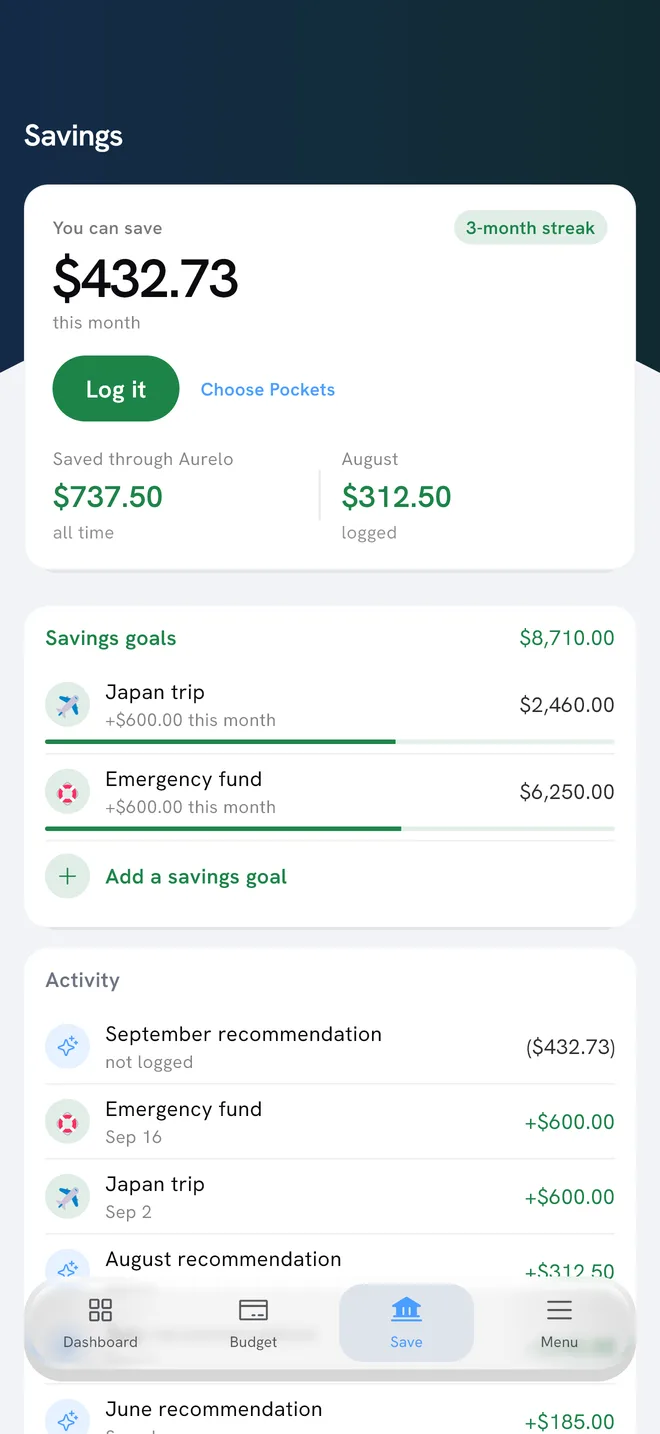
In Aurelo: Create a savings goal called “Holidays” with your total as the target. When you move money into savings in your own bank, tap Log it, and the goal fills in toward the target. Aurelo tracks it for you; it never moves or holds the money.
Step 5: Track while you shop
The plan only helps if you check it before each purchase, not after the season ends.
- Keep a running tally by line: gifts, food, travel and so on.
- Check the list before you buy. Is this person’s gift already covered? Is this within their tier?
- Watch the extras. Shipping, gift wrap, a second gift “just in case,” and last-minute stocking stuffers are where holiday budgets quietly leak.
- Keep receipts until after the returns window, and subtract refunds from what you’ve spent.
When one line runs over, move money from another line to cover it rather than adding to the total. If gifts go over by $30, maybe decorations can wait until next year’s post-holiday sales. The total holds; the lines flex. How to stop overspending has more habits that help in the moment.
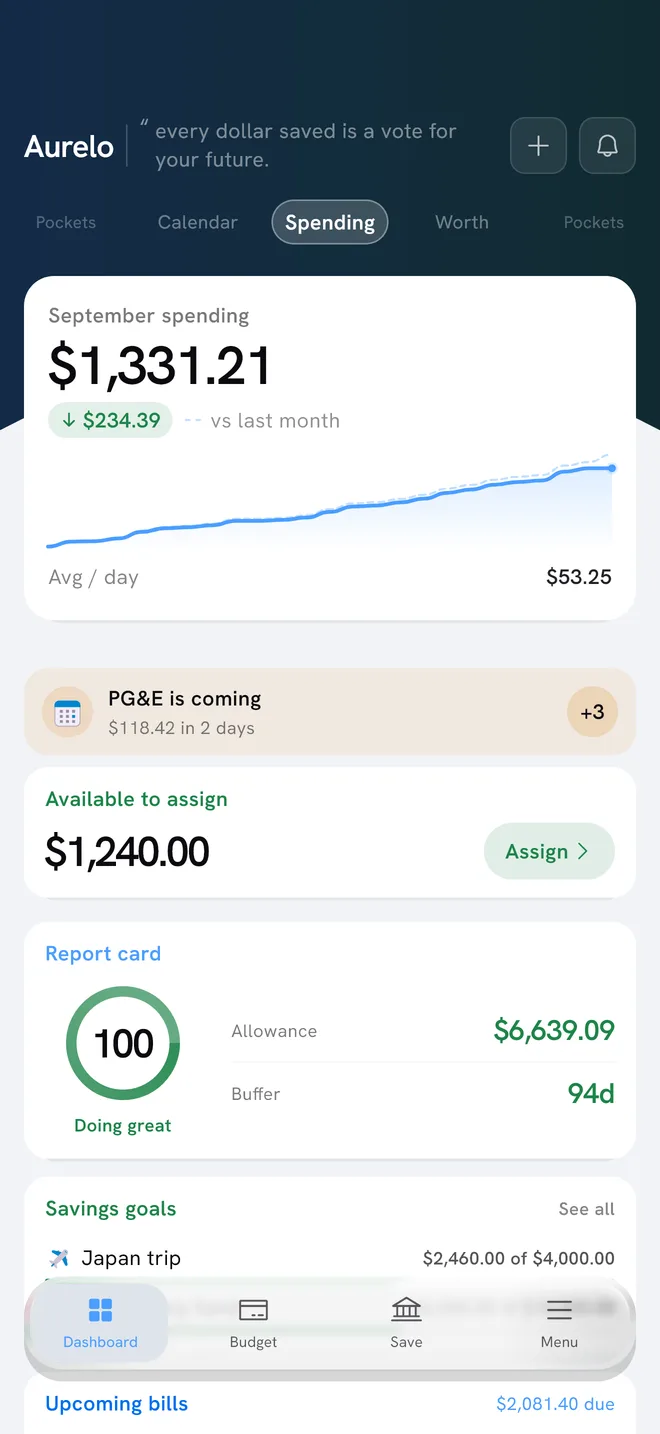
In Aurelo: Give the holidays their own pocket for the season. Each purchase comes out of that pocket, and you can see what’s left at a glance. If it runs over, a Reshuffle moves money from another pocket to cover it, so the rest of your budget stays honest.
Step 6: Keep credit cards on your side
Cards are convenient for holiday shopping, and some offer purchase protection. The risk is using them to spend money you haven’t saved. In the Federal Reserve’s survey for 2025, 45 percent of credit card owners said they had carried a balance at least once during the prior 12 months.2 A holiday season paid off over months tends to cost more than it looked in December.
A simple rule: only put on a card what’s already in your holiday savings, and pay the statement in full when it arrives. How to budget when you pay with credit cards shows how to keep card purchases tied to money you already have.
After the holidays
A few minutes in January makes next year easier:
- Compare planned versus actual for each line. Which ones ran over?
- Write down next year’s number while this year is fresh.
- Start next year’s goal now. $75 a month from January gives you $825 by the end of November.
The holidays aren’t a surprise. With a number chosen early and money saved ahead, they don’t have to feel like one.
In Aurelo: Aurelo is a budgeting app for iPhone, free during its open beta. Set up pockets for the season, track a holiday savings goal, and use the Money Calendar to see how December’s travel and gifts sit alongside your regular bills.
Common questions
How much should I budget for the holidays?
Start from what you can afford, not from what you spent last year or what other people spend. Look at what you can set aside each month between now and December, multiply by the months left, and treat that as your ceiling for the whole season.
How much should I spend on each person for gifts?
There's no right number. Decide your gift total first, list everyone you plan to buy for, and divide. Many people use tiers, a larger amount for a few close people and a smaller set amount for everyone else, so the list fits the total instead of stretching it.
When should I start saving for Christmas?
The earlier the better, because each extra month lowers the monthly amount. Starting in September gives you about three to four months. Some people keep a small holiday amount going all year, which turns December into a planned expense rather than a shock.
How do I stop overspending during the holidays?
Write the list and the total before you shop, keep a running tally of what you've spent, and check it before each purchase. Watch the small add-ons like wrapping, shipping and last-minute extras, which are where most budgets quietly slip.
Sources
- NRF Expects Holiday Sales to Surpass $1 Trillion for the First Time in 2025 , National Retail Federation, 2025
- Economic Well-Being of U.S. Households in 2025: Credit , Federal Reserve Board, 2026
Written by the Aurelo team. We build Aurelo, a budgeting app that reads your accounts read-only and never moves your money. Every claim about the app is checked against the app itself, and every figure links to its source. This is general education, not financial, tax or legal advice.