Key takeaways
- Build your first budget from what you actually spent in the last few months, not from what you hope to spend.
- Bills, needs and wants, with ten to fifteen lines in total, is enough structure to start.
- Divide yearly bills by twelve and set that aside monthly so they never ambush a month.
- When a line runs over, cover it from another line; the first two or three months are a draft.
A budget is simply a plan for your money before the month spends it for you. The math is easy. What makes it hard is that most first budgets are built from guesses, and guesses tend to be optimistic. A few weeks in, reality doesn’t match the plan, and it starts to feel like the budget failed when it was really the numbers.
This guide walks through a method that starts from what you actually spend. It works on paper, in a spreadsheet or in an app. You can do the first version tonight in about an hour.
Step 1: Find your real monthly take-home pay
Start with the money that actually arrives in your account after taxes, retirement contributions and health insurance come out. That’s your take-home pay, and it’s the only number your budget can spend.
- If you’re paid twice a month, add the two paychecks.
- If you’re paid every two weeks, use two paychecks per month for the plan. Two months a year you’ll get a third; treat it as a bonus rather than counting on it. How to budget a biweekly paycheck goes into the details.
- If your income varies, use a cautious figure, such as your lowest month in the last six. Budgeting on an irregular income covers this in more detail.
Step 2: Look back before you plan forward
This is the step most budgets skip, and it’s the one that matters most. Pull your last two or three months of bank and credit card statements. Go through them and total what you spent in each area: rent, groceries, gas, eating out, shopping, subscriptions and so on.
It’s tedious, and it’s often surprising. It’s common to underestimate food and small purchases, and to forget a subscription or two. Food adds up faster than it feels: in the Bureau of Labor Statistics’ spending survey for 2024, the average US household spent $10,169 on food over the year, and $3,945 of that was food away from home.1 Your numbers will differ, but that’s roughly $330 a month on eating out for an average household, spread across purchases small enough to forget. The point is not to judge the past but to get honest starting numbers. A budget built on what you really spend has a chance of holding. One built on what you wish you spent usually doesn’t.
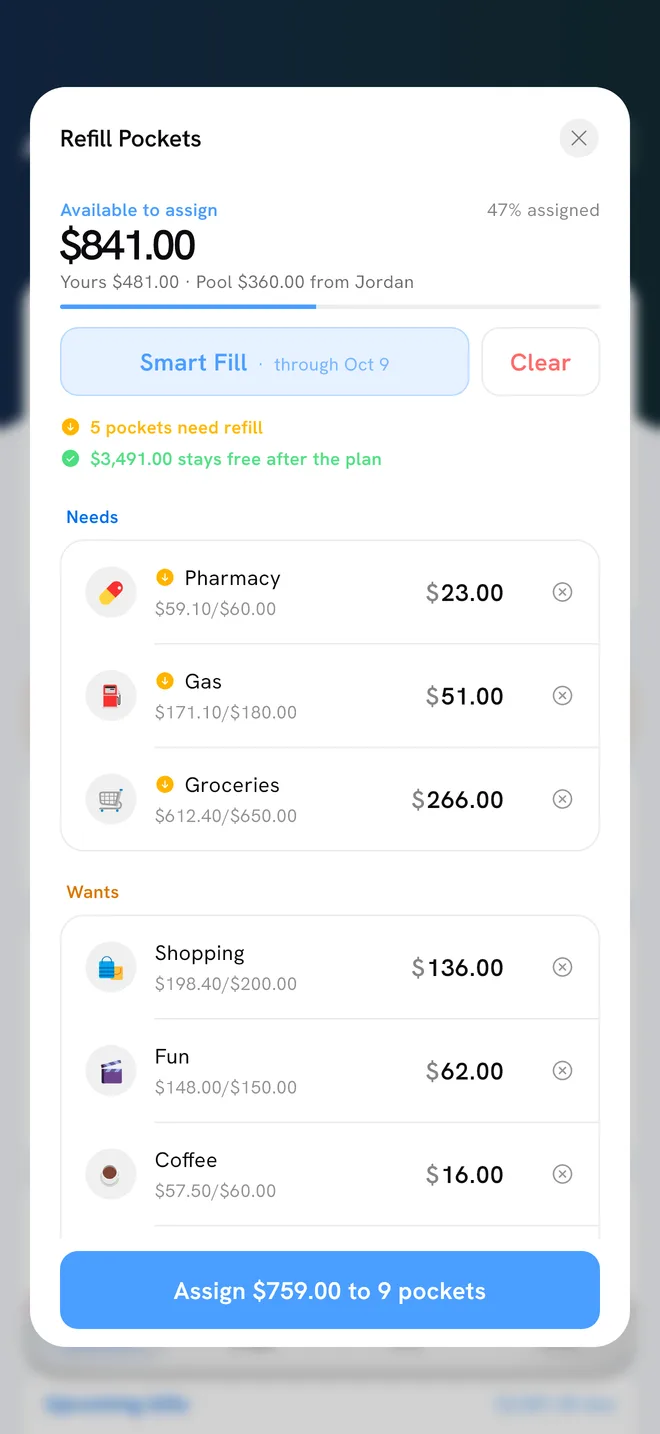
In Aurelo: This is the step Aurelo does for you. Connect your checking account and credit cards through a read-only connection, and it reads your last six months of transactions, sorts them, and suggests pockets with amounts that match how you actually spend. You edit anything that looks off.
Step 3: Sort spending into bills, needs and wants
Three groups are enough to see where your money goes:
- Bills. Fixed amounts that are due on a date: rent or mortgage, utilities, phone, insurance, loan payments, subscriptions.
- Needs. Essentials that vary month to month: groceries, gas, household supplies, medical costs.
- Wants. Everything else: eating out, entertainment, shopping, hobbies, travel.
Each group gets a few named lines inside it. You might know this as the envelope method, where each line has its own envelope of cash. In Aurelo these lines are called pockets. Keep the list short at first. Ten to fifteen lines is plenty; you can split things up later if you need more detail. If you want a starting list to pick from, see budget categories.
Expect housing to be the biggest line. In the same 2024 survey, housing averaged $26,266 a year, or about $2,189 a month, which was 33.4 percent of average household spending.1
Step 4: Don’t forget the bills that aren’t monthly
Some of the most painful budget surprises are bills you knew about but only pay once or twice a year: car insurance, a membership renewal, a card’s annual fee, a holiday. Add up what you pay for these over a year and divide by twelve. Set that amount aside each month so the money is waiting when the bill arrives. This is often called a sinking fund, and sinking funds for annual expenses walks through it step by step.
Step 5: Plan what’s left
Subtract bills, needs, wants and yearly set-asides from your take-home pay. Whatever remains gets a purpose too: an emergency fund, extra payments on a debt, or a goal like a trip. Planning every dollar this way is the idea behind zero-based budgeting. It doesn’t mean you have to spend it all. It means nothing is left floating without a plan.
If the number comes out negative, that’s useful information, not a failure. Look at wants first, then needs, and see what can shift.
A worked example
Here’s an example budget for someone with a take-home pay of $4,200 a month. The amounts are illustrations; yours will look different.
| Group | Line | Monthly |
|---|---|---|
| Bills | Rent | $1,450 |
| Bills | Utilities | $150 |
| Bills | Car insurance | $120 |
| Bills | Phone | $60 |
| Bills | Internet | $60 |
| Bills | Subscriptions | $45 |
| Needs | Groceries | $550 |
| Needs | Gas | $180 |
| Needs | Household | $60 |
| Needs | Medical | $40 |
| Wants | Eating out | $260 |
| Wants | Shopping | $150 |
| Wants | Entertainment | $120 |
| Wants | Personal care | $80 |
| Yearly | Annual bills (about $1,200 a year) | $100 |
| Savings | Emergency fund | $500 |
| Debt | Extra card payment | $275 |
| Total | $4,200 |
In this example, bills are $1,885, needs are $830, wants are $610, yearly set-asides are $100, and $775 goes toward savings and debt. Every dollar of the $4,200 has a place.
Step 6: Track as you go, and adjust
A budget is only useful if you can see where you stand mid-month. Check in at least once a week. For each line, the question is simple: how much is left?
When a line runs over, and one will, move money from another line to cover it. Groceries went over by $40? Take $40 from eating out. That’s not cheating. It’s the budget doing its job, because you decided where the extra came from instead of finding out later. Why budgets fail goes through this and the other common reasons plans fall apart.
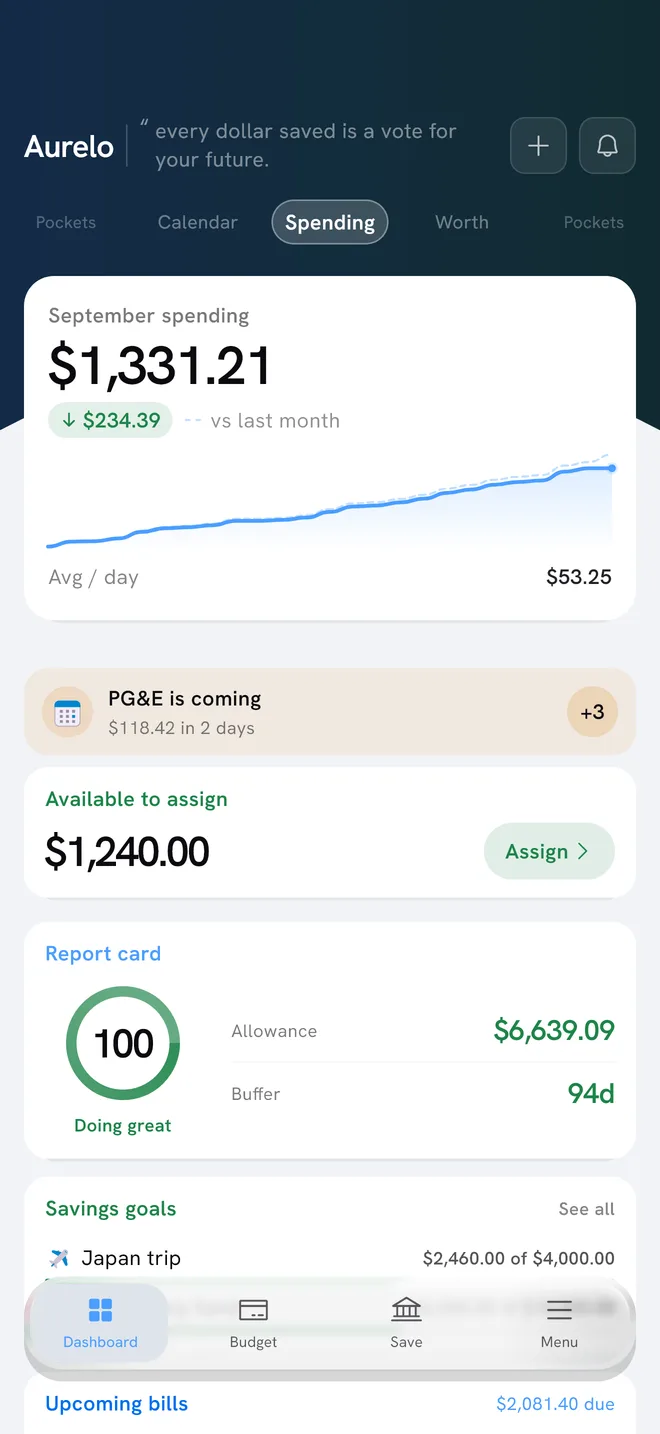
In Aurelo: Each pocket shows what’s left, and if one runs over, Reshuffle lets you cover it from another pocket. Today’s Allowance tells you what you can spend today after the bills due before your next payday.
Step 7: Review at the end of the month
At the end of each month, look at which lines ran over and which had money left. Adjust next month’s numbers toward reality. After two or three months, the plan starts to fit, and it takes a lot less attention.
A few habits that help
- Round up your bills. A small cushion on utilities saves you from rebalancing every month.
- Give yourself some spending money. A budget with no room for small pleasures rarely lasts. A modest “fun” line is part of a plan that holds.
- Keep an emergency fund in view. Even a small one turns a surprise bill from a crisis into an inconvenience. In the Federal Reserve’s 2025 survey, 63 percent of adults said they would cover a $400 emergency expense with cash or its equivalent, which leaves 37 percent who would have to pay some other way, or couldn’t pay at all.2 See how big your emergency fund should be.
- Expect the first month to be messy. It’s a draft. That’s normal.
Making it easier
You can do all of this with a spreadsheet and your bank statements. The hard parts are the look-back in Step 2 and keeping track in Step 6, which is where an app earns its place.
Aurelo is free during its open beta on iPhone. It can build your first budget from six months of real spending, or you can skip the bank connection, pick your pockets, enter a starting amount and log spending by hand. Either way, the method above is the same.
Common questions
How do I start budgeting for the first time?
Start with what already happened. Pull your last two or three months of bank and card statements, total what you spent in each area, and use those totals as your first plan. Adjust from there rather than starting with ideal numbers.
What is the easiest way to make a budget?
Group your spending into three sets: bills that are fixed, needs that vary, and wants. Give each a monthly amount based on past spending, set aside something for yearly bills, and plan what's left toward savings or debt.
Should I budget with my gross or net income?
Use your take-home pay, the amount that actually lands in your account after taxes and deductions. That's the money you can spend and plan, so it's the number your budget has to balance against.
How long does it take for a budget to start working?
Expect the first month to be a draft. It usually takes two or three months of adjusting before the numbers settle, because real spending always turns up something the first plan missed.
Sources
- Consumer Expenditures--2024 , U.S. Bureau of Labor Statistics, 2025
- Economic Well-Being of U.S. Households in 2025: Savings and Investments , Federal Reserve Board, 2026
Written by the Aurelo team. We build Aurelo, a budgeting app that reads your accounts read-only and never moves your money. Every claim about the app is checked against the app itself, and every figure links to its source. This is general education, not financial, tax or legal advice.