Key takeaways
- A zero-based budget plans every dollar of take-home pay until the amount left to plan is exactly $0.
- The zero is on paper: money planned for savings stays in your account with a purpose attached.
- Moving money between lines when one runs over is the method working, not failing.
- It pairs well with 50/30/20: use the percentages as a direction and plan every dollar within them.
Zero-based budgeting sounds more technical than it is. The whole idea fits in one line: your income minus everything you plan equals zero. In other words, you plan every dollar before the month starts, so none of it is left drifting without a purpose.
It’s a long-standing, straightforward method, and it works whether you earn a little or a lot. It started in business, not households: it gained attention in 1970 when Peter Pyhrr wrote in the Harvard Business Review about Texas Instruments’ experience with it, and Jimmy Carter later used it for Georgia’s state budget and brought it to the federal government as president.1 The household version keeps the core idea: every dollar is planned from scratch rather than carried over by habit. Here’s how it works, a worked example, and where it helps and where it can get in the way.
What “zero” actually means
The most common confusion is the name. A zero-based budget doesn’t mean you spend everything, and it doesn’t mean your bank account hits zero. The zero is on paper.
Every dollar gets a job in the plan. Some of those jobs are spending: rent, groceries, gas. But some are saving: an emergency fund, a trip, next year’s car insurance. Money planned for savings stays in your account. It simply isn’t “spare” anymore, because you’ve decided what it’s for.
The alternative, which most people start with, is to plan the obvious bills and assume whatever’s left over is fine. The trouble is that leftover money tends to disappear in small purchases, and at the end of the month there’s nothing left and no clear idea where it went. That end-of-month squeeze is common: in the Federal Reserve’s 2025 survey, 41 percent of adults said they always or often had money left over at the end of the month, which leaves most adults without that regular margin.2
How to build a zero-based budget
- Start with your take-home pay for the month. Use what actually lands in your account after taxes and deductions. If your pay varies, use a cautious figure.
- List your bills. Rent, utilities, insurance, phone, loan minimums, subscriptions. These are usually fixed.
- List your needs. Groceries, gas, household basics. Use your real spending from recent months, not a hopeful number.
- List your wants. Eating out, entertainment, shopping. Be honest here; a plan with no room for enjoyment rarely lasts.
- Set aside for yearly bills. Add up what you pay once or twice a year, divide by twelve, and plan that amount monthly.
- Plan the rest. Whatever’s left goes to savings goals, extra debt payments, or both, until the amount left to plan is exactly $0.
If you’ve never built a budget before, how to make a budget covers the first steps, especially pulling real numbers from your past spending.
A worked example
Here’s an example for someone with take-home pay of $3,800 a month. The amounts are illustrations.
| Plan | Monthly | Left to plan |
|---|---|---|
| Take-home pay | $3,800 | |
| Rent | $1,300 | $2,500 |
| Utilities, phone, internet | $250 | $2,250 |
| Car insurance | $110 | $2,140 |
| Subscriptions | $40 | $2,100 |
| Groceries | $500 | $1,600 |
| Gas and transit | $150 | $1,450 |
| Household | $50 | $1,400 |
| Eating out | $220 | $1,180 |
| Entertainment and hobbies | $150 | $1,030 |
| Shopping | $130 | $900 |
| Yearly bills set-aside | $100 | $800 |
| Emergency fund | $500 | $300 |
| Extra student loan payment | $300 | $0 |
The last column is the heart of the method. You keep planning until it reaches $0. In this example that happens with $500 toward an emergency fund and $300 toward a loan. Someone else might choose a trip fund or a bigger grocery budget. The method doesn’t decide your priorities; it just makes sure you’ve made a decision.
What happens during the month
A zero-based budget is a plan, and plans meet reality. Two things happen regularly.
A line runs over. Groceries come in $40 higher than planned. In a zero-based budget, you cover it by moving $40 from another line, like eating out. The total still balances. This is normal and expected; it’s the method working, not failing.
Extra money arrives. A refund, a gift, a third paycheck. It starts unplanned, so you plan it: toward savings, a debt, or a line that’s running tight. Once it’s planned, you’re back to zero. (If you’re paid every two weeks, budgeting a biweekly paycheck covers how to handle those third-paycheck months.)
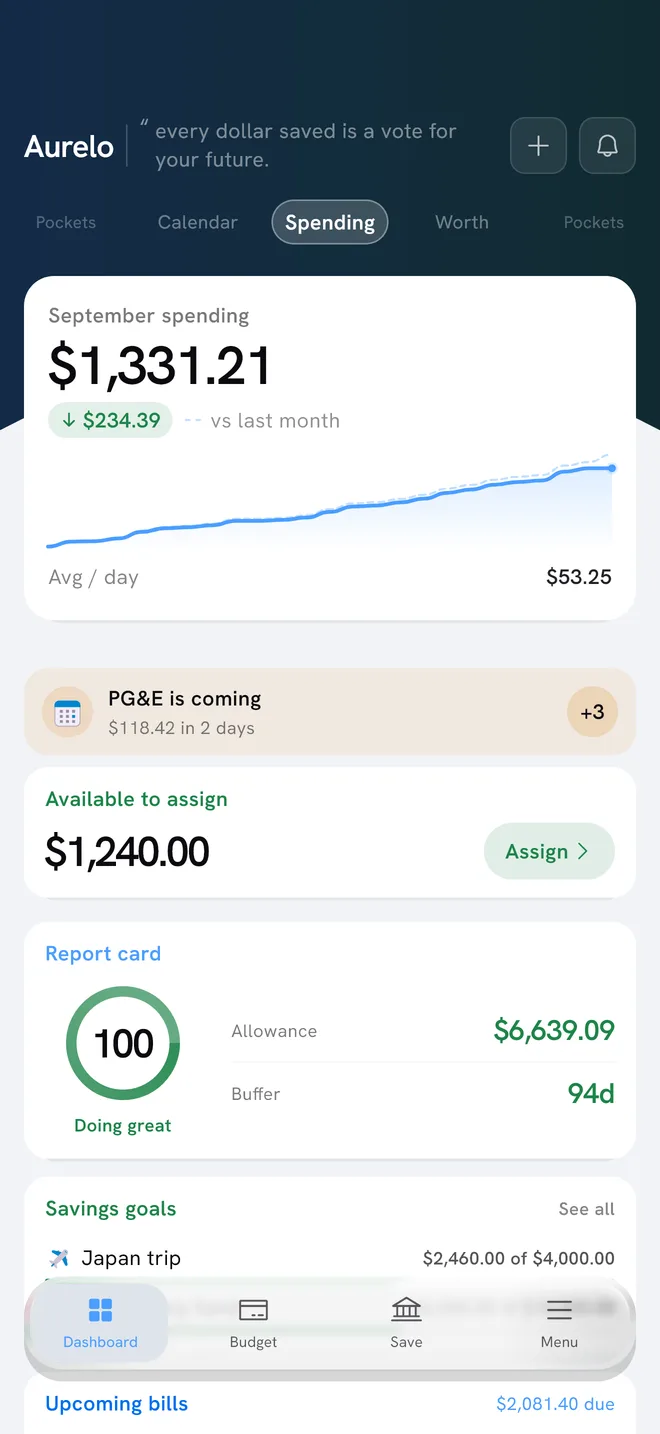
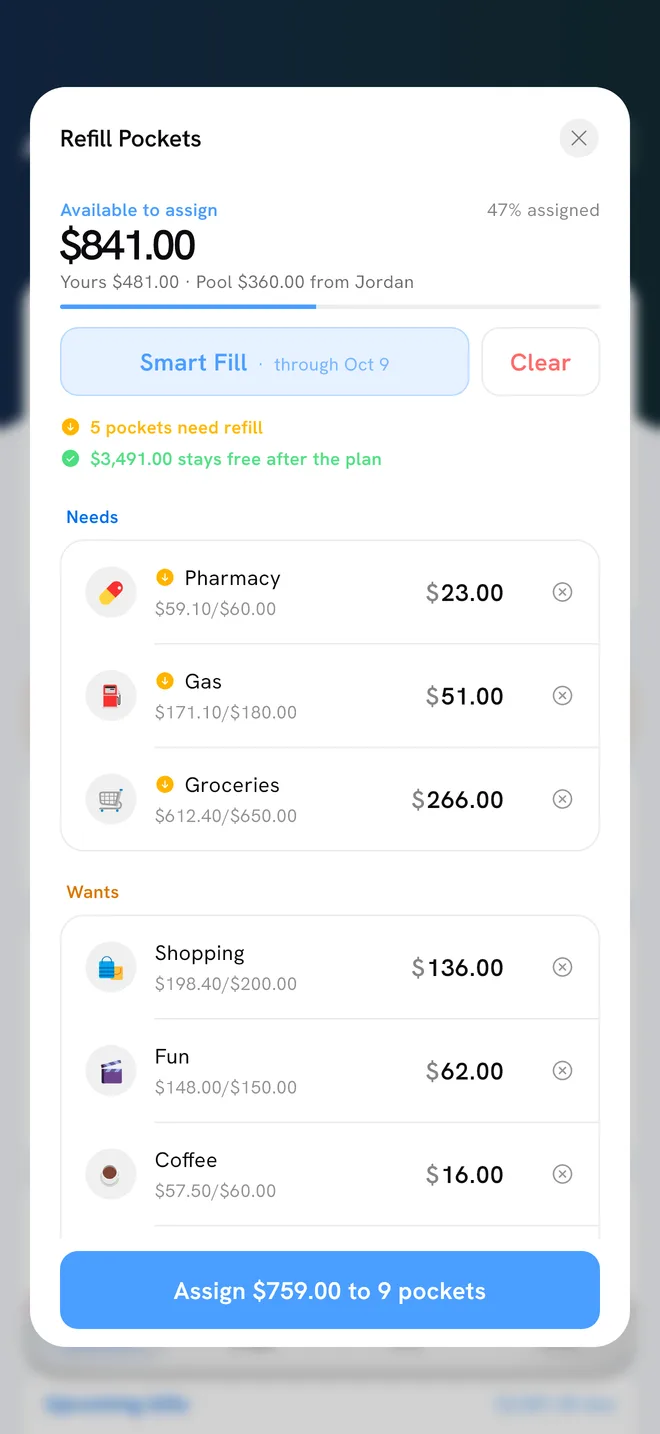
In Aurelo: Money you have that isn’t in a pocket yet shows as Available to assign. When that reaches $0, every dollar has been planned, which is a zero-based budget. Refill Pockets and Smart Fill help you get there: Smart Fill proposes amounts through your next payday, covering the bills due before then first, and you approve or change it.
The pros
- Nothing slips through. Because every dollar is planned, small leaks are easier to spot.
- Savings becomes a line, not a leftover. You decide on savings at the start of the month instead of hoping for some at the end. That’s the idea behind paying yourself first.
- It works at any income. The method is about decisions, not amounts.
- It makes trade-offs visible. If you want more for one thing, you can see exactly what has to give.
The cons
- The setup takes work. Planning every dollar the first time takes an hour or more, especially if you’re pulling numbers from statements.
- It can feel strict. If you plan too tightly, one ordinary overspend can feel like failure. Leave some room, and expect to move money between lines.
- Irregular income makes it harder. If you don’t know exactly what’s coming in, you have to plan from a cautious figure and add more as it arrives. See budgeting on an irregular income.
- It needs regular check-ins. A zero-based budget works best when you look at it every week or so.
Zero-based budgeting vs the 50/30/20 rule
The 50/30/20 rule is another popular method. It splits take-home pay into fixed percentages: half for needs, 30% for wants, 20% for savings and debt. It’s quicker to set up, but it’s a guideline rather than a full plan, and the percentages don’t fit everyone.
Zero-based budgeting is more detailed. The two can work together: you can use 50/30/20 as a rough target and then plan every dollar within it.
Is it right for you?
Zero-based budgeting suits you if you want a clear picture of where every dollar goes, you’re trying to save or pay off debt more deliberately, or you’ve tried looser budgets and found money disappearing. It’s less of a fit if you want something with almost no setup or ongoing attention.
When a zero-based budget falls apart, the method is rarely the problem. More often it was planned with guessed numbers. Why budgets fail covers that and the other usual suspects.
In Aurelo: Aurelo suggests pockets and amounts from your last six months of real spending, so your zero-based plan starts close to reality. Each pocket shows what’s left, and if one runs over, Reshuffle lets you cover it from another pocket.
Common questions
What is zero-based budgeting in simple terms?
It's a budget where your income minus everything you've planned equals exactly zero. Every dollar gets a purpose, whether that's rent, groceries, savings or fun, so none of it is left without a plan.
Does a zero-based budget mean I have zero dollars in the bank?
No. The zero is on paper, not in your account. Money you plan toward savings or a future bill stays in your bank; it just has a purpose attached to it.
Is zero-based budgeting good for beginners?
It can be, if you start from your real past spending rather than guesses. The method itself is simple. What trips beginners up is usually the setup work, not the idea.
What is an example of a zero-based budget?
With $3,800 of take-home pay, you might plan $1,700 for bills, $700 for needs, $500 for wants, $100 for yearly bills, $500 for savings and $300 for extra debt payments. Together they add up to $3,800, leaving $0 unplanned.
Sources
- Zero-based budgeting: everything old is new again , The Conversation, 2015
- Economic Well-Being of U.S. Households in 2025: Income and Expenses , Federal Reserve Board, 2026
Written by the Aurelo team. We build Aurelo, a budgeting app that reads your accounts read-only and never moves your money. Every claim about the app is checked against the app itself, and every figure links to its source. This is general education, not financial, tax or legal advice.