Key takeaways
- Paying yourself first means saving at the start of the month, not with whatever is left at the end.
- Start with an amount small enough to survive a bad month, then raise it.
- Move the money on payday, into an account separate from everyday spending.
- Pay yourself first only works if bills are planned too; it's not a reason to overdraw.
Most people try to save the same way: pay the bills, live the month, and put away whatever is left. The trouble is that there rarely is anything left. Spending tends to expand to fill the money available, not out of carelessness, but because a balance that looks free usually gets used.
Paying yourself first flips the order. Savings becomes the first thing that happens when money arrives, and the rest of the month is planned around what’s left. It’s one of the oldest ideas in personal finance, and it has lasted because it works with human nature instead of against it.
This guide covers what it means in practice, how to choose an amount you can keep up, when and where to move the money, and how to make it work alongside bills and debt.
This is general education, not personal financial advice.
Why saving last so often fails
Saving at the end of the month relies on willpower every single day. Each purchase is a small decision, and none of them feels like the one that ruins the savings goal. By the 28th, the goal is gone and nobody chose to give it up.
The numbers show how thin the margin is for many households. The Bureau of Economic Analysis reports the personal saving rate, the share of disposable income people save after taxes and spending. For July 2026 it was 3.0 percent.1 That’s a national average, so many people save more and many save nothing at all, but it shows how little tends to be left over.
And the cushion matters. In the Federal Reserve’s survey of 2025, 63 percent of adults said they would cover a $400 emergency expense using cash or its equivalent, a share that has barely moved in several years.2 Saving first is one of the most direct ways to join that group.
How paying yourself first works
The method itself is simple:
- Decide an amount you’ll save from each paycheck.
- On payday, move that amount out of checking and into savings, before any discretionary spending.
- Budget the rest. Bills, needs and wants all come from what remains.
The shift is small but important. Savings stops being a leftover and becomes a line in your plan, the same as rent.
Step 1: Choose an amount you can keep
The right amount is one you’ll still be saving in month six. It’s better to save $50 every paycheck for a year than $400 for two months and then stop.
A few ways to pick a starting number:
- A percentage of take-home pay. Some people start at 5 percent, some at 10. The percentage scales with your income if it changes.
- A fixed dollar amount. Easier to plan around on a steady income.
- Your goal, worked backwards. Want $1,200 for a trip in a year? That’s $100 a month, or about $46 per biweekly paycheck.
Here’s an example with take-home pay of $4,000 a month, saving 10 percent:
| Monthly plan (example) | Amount |
|---|---|
| Take-home pay | $4,000 |
| Pay yourself first: savings | −$400 |
| Rent and utilities | −$1,550 |
| Other bills (phone, insurance, loans) | −$450 |
| Groceries and household | −$550 |
| Transport | −$250 |
| Everything else (eating out, fun, personal) | −$800 |
| Left unplanned | $0 |
The savings line comes first, and every other dollar has a plan. That’s the same idea as zero-based budgeting, with savings at the top of the list.
If 10 percent doesn’t fit, pick a smaller number and start. You can raise it every time you get a raise or finish paying off a debt.
Step 2: Move it on payday
Timing is most of the method. If the money sits in checking for two weeks, it tends to get spent. Moving it the day your pay lands keeps it out of reach.
Two common ways to do that:
- Split your direct deposit. Many employers let you send part of each paycheck straight to a different account.
- Schedule a transfer in your bank for payday or the day after.
Either way, the decision is made once, not every month.
Step 3: Give the money somewhere to go
Savings with no purpose is easy to raid. Savings with a name is easier to protect. Common first destinations:
- A starter emergency cushion, so surprises don’t go on a card. How big your emergency fund should be helps you size it.
- Yearly bills, like insurance or registration, set aside monthly in a sinking fund.
- A specific goal: a trip, a move, a car repair you know is coming.
Keep the money in an account separate from everyday spending, even a second savings account at the same bank. The small extra step of moving it back is often enough to make you pause.
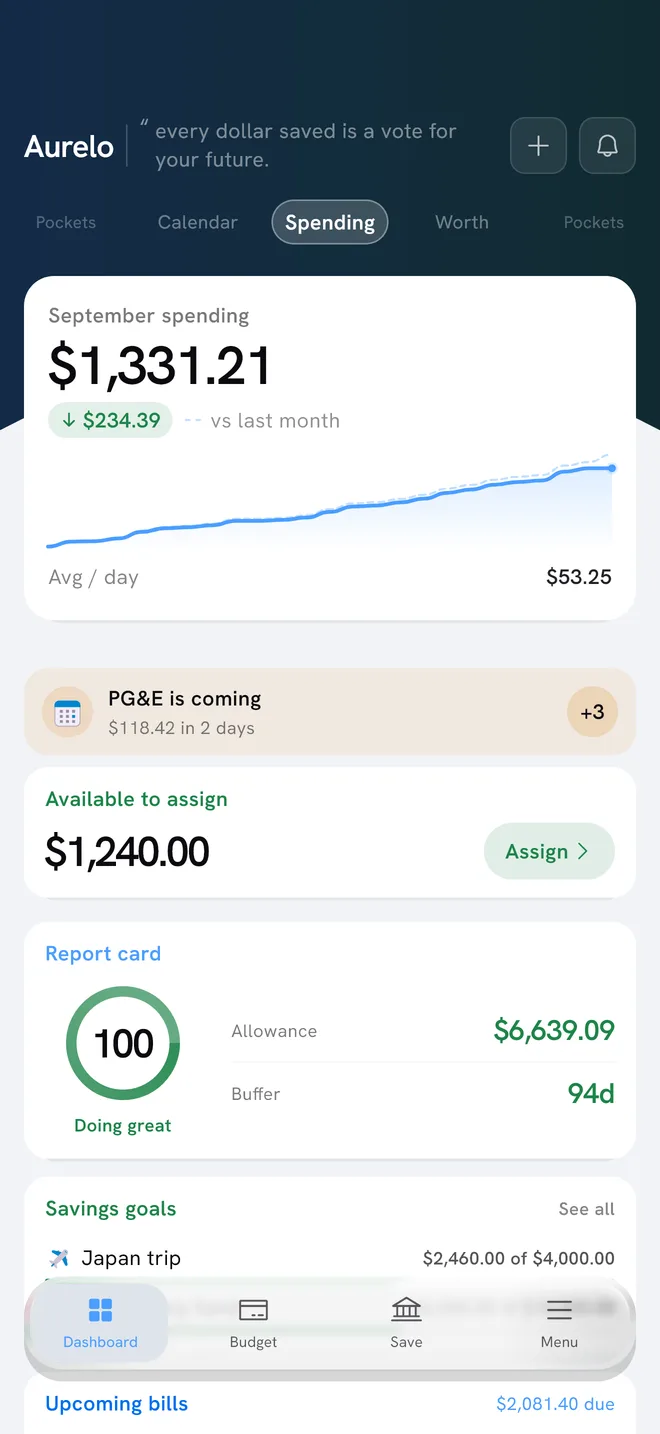
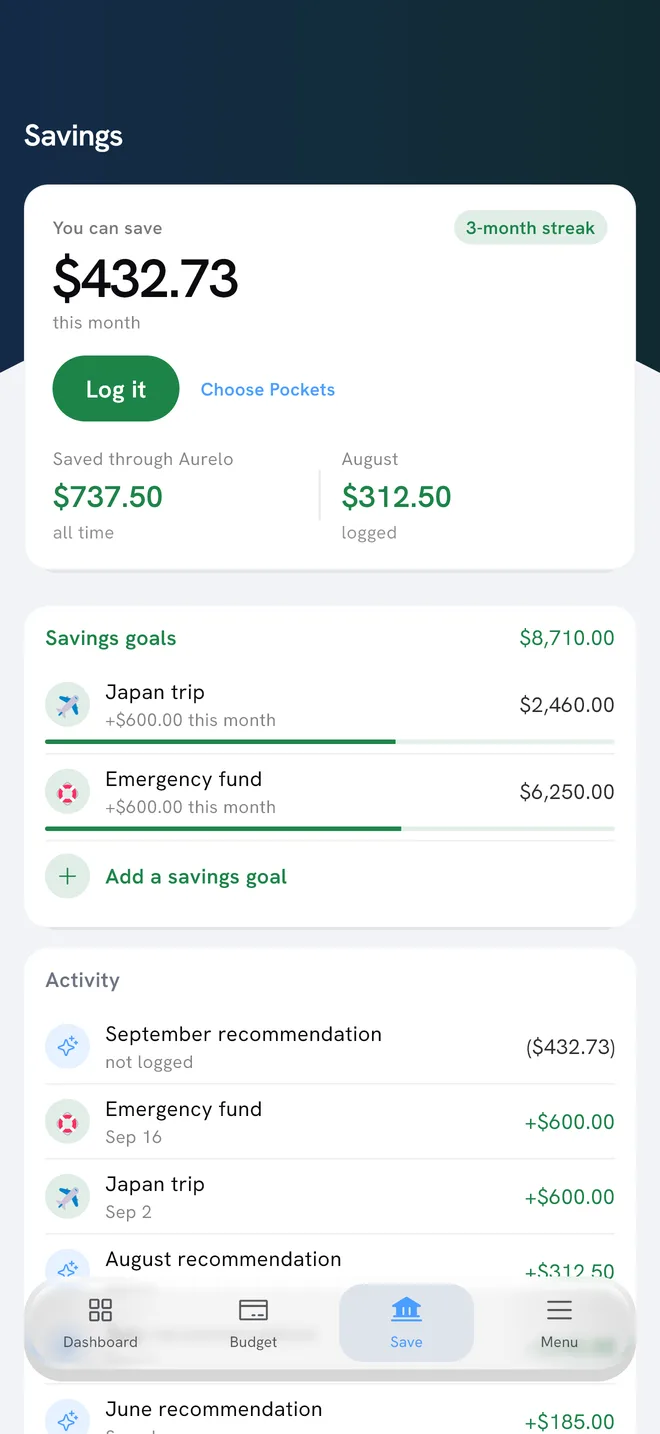
In Aurelo: The Save tab shows “You can save $X this month”, worked out from what’s left after your pockets and the bills still ahead. Aurelo doesn’t move money. You move it yourself in your bank, then tap Log it, and Aurelo tracks the running total and a monthly streak.
Pay yourself first, without overdrawing
Paying yourself first is not the same as ignoring your bills. If rent is due on the 1st and payday is the 3rd, moving savings out the moment your pay lands could leave checking short when the next bill hits. The method works best when you already know what’s coming.
A few guardrails:
- Know the bills due before your next paycheck before you move anything.
- Keep a small buffer in checking so timing mistakes don’t turn into fees. Avoiding overdraft fees covers the routine.
- If a month is tight, save less, not zero. Even $20 keeps the habit alive.
When you’re also paying off debt
High-interest debt makes this trickier, because every dollar in savings is a dollar not reducing a balance that charges interest. There’s no single right split, but a common pattern is:
- Pay every minimum on time.
- Pay yourself first with a small amount until you have a starter cushion.
- Send extra money to the debt.
- Once the debt is gone, roll that payment into savings.
The cushion is what stops the next car repair from going back on the card. Debt snowball vs avalanche covers the debt side.
On an irregular income
If your pay varies, a fixed dollar amount can be too much in a lean month and too little in a good one. Save a percentage of each payment as it arrives instead. In a good month, you save more automatically. In a slow one, you still save something. Budgeting on an irregular income goes deeper.
Keeping it going
Habits last when they’re visible and small wins are noticed.
- Track the total. Watching a number grow is motivating in a way individual transfers aren’t.
- Count streaks, not perfection. A month where you saved less still counts. A month skipped isn’t the end.
- Raise the amount on good news. A raise, a paid-off loan or a cancelled bill is the easiest moment to increase savings, because you never got used to spending it.
In Aurelo: Savings goals, such as “Japan trip” or “Emergency fund”, show your progress toward a target. The Save tab also keeps a monthly streak alongside your running total, which makes the habit easy to see.
The short version
- Decide what to save from each paycheck, starting small enough to keep.
- Move it on payday, before discretionary spending.
- Give it a purpose and keep it separate from checking.
- Check the bills due before payday so saving first never causes an overdraft.
- Raise the amount whenever your income grows or a bill disappears.
Common questions
What does pay yourself first mean?
It means treating savings as the first bill you pay each payday. You move a set amount into savings as soon as income arrives, then budget the rest, instead of saving whatever happens to be left at the end of the month.
How much should I pay myself first?
There's no single right number. Many people start with a small, fixed amount or a percentage such as 5 or 10 percent of take-home pay, then raise it as their budget allows. Choose an amount you could keep saving even in a tight month.
Should I pay myself first if I have credit card debt?
Many people keep a small savings habit going while paying down debt, so surprise costs don't go back on a card. How to split money between the two depends on your situation, so treat this as general guidance, not advice.
Does paying yourself first work on an irregular income?
Yes, with a tweak. Save a percentage of each payment as it arrives rather than a fixed dollar amount, so good months save more and lean months still save something.
Sources
- Personal Saving Rate , U.S. Bureau of Economic Analysis, 2026
- Economic Well-Being of U.S. Households in 2025: Savings and Investments , Federal Reserve Board, 2026
Written by the Aurelo team. We build Aurelo, a budgeting app that reads your accounts read-only and never moves your money. Every claim about the app is checked against the app itself, and every figure links to its source. This is general education, not financial, tax or legal advice.