
Key takeaways
- Budget by semester first, then divide it into months or weeks you can actually live on.
- A financial aid refund or summer savings is a lump sum that has to last; split it before you spend it.
- Cover rent, food, transport and phone first, then plan everything else from what's left.
- A small cushion of even a few hundred dollars keeps one surprise from turning into card debt.
College is often the first time you’re fully in charge of your own money, and it arrives in an awkward shape. Income comes in lumps (an aid refund, a summer’s savings, a part-time paycheck that changes every week), while costs come on their own schedule: rent on the first, books at the start of term, flights home at the holidays.
A budget for college doesn’t have to be complicated. It has to answer one question: will the money I have now last until the next money arrives? This guide shows how to build one around that question.
Know the big numbers first
College costs vary enormously, but the averages give useful context. According to the College Board, average published tuition and fees for in-state students at public four-year colleges are $11,950 for 2025–26.1 The College Board’s average full student budget for those same students is $30,990, more than two and a half times the tuition figure.1
That gap is the point: tuition is only part of the cost of being a student. Much of the rest is living costs such as housing, food, books and getting around, and those are the part your day-to-day budget controls.
Look up your own school’s cost of attendance. It usually lists estimates for housing, food, books and personal costs, which make a good first draft for your plan.
Step 1: Budget by semester, then by month
Most student money arrives per term, so start there.
- List your money for the term. Aid refund, scholarships, what family is contributing, savings, and a cautious estimate of part-time pay.
- List the lump costs. Books and supplies, a housing deposit, a parking permit, a laptop repair fund, a flight home.
- Subtract the lumps from the money. What’s left is what you’ll live on.
- Divide by the months (or weeks) in the term. That’s your monthly or weekly spending limit.
For example, if you have $6,000 for a four-and-a-half-month semester and $800 of lump costs, you have $5,200 to live on, or about $1,155 a month. If you’re not paying rent, that goes much further; if you are, rent comes out first.
Step 2: Cover the essentials first
Before any fun money, fund the things that keep you in school:
| Monthly essential (example, off-campus) | Amount |
|---|---|
| Rent share, including utilities | $650 |
| Groceries | $280 |
| Phone | $35 |
| Transport (bus pass or gas) | $50 |
| Renter’s insurance and small bills | $20 |
| Essentials total | $1,035 |
With the $1,155 monthly figure from the example above, that leaves $120 a month for everything else: eating out, going out, clothes and small purchases. That’s tight, and seeing it in advance is exactly why the budget matters. It tells you that a part-time job, a meal plan, a cheaper room or cooking more might be necessary, before you find out in November.
If you live in a dorm with a meal plan, your essentials are much smaller, and more of your budget is flexible.
Step 3: Pay yourself a steady allowance
The hardest part of a lump sum is that the balance looks big. $4,000 in checking in September feels like a lot of money. It’s actually four months of living.
Two ways to keep it steady:
- Weekly allowance. Move one week’s spending money into a separate account or set it aside mentally each week. When the week’s money is gone, you wait for Monday.
- Monthly transfer. Keep the lump sum in savings and move one month’s budget to checking on the first.
Either way, you’re recreating a paycheck from a lump sum, which makes the rest of the budget far easier to follow. The same technique works for anyone with uneven pay; see budgeting on an irregular income.
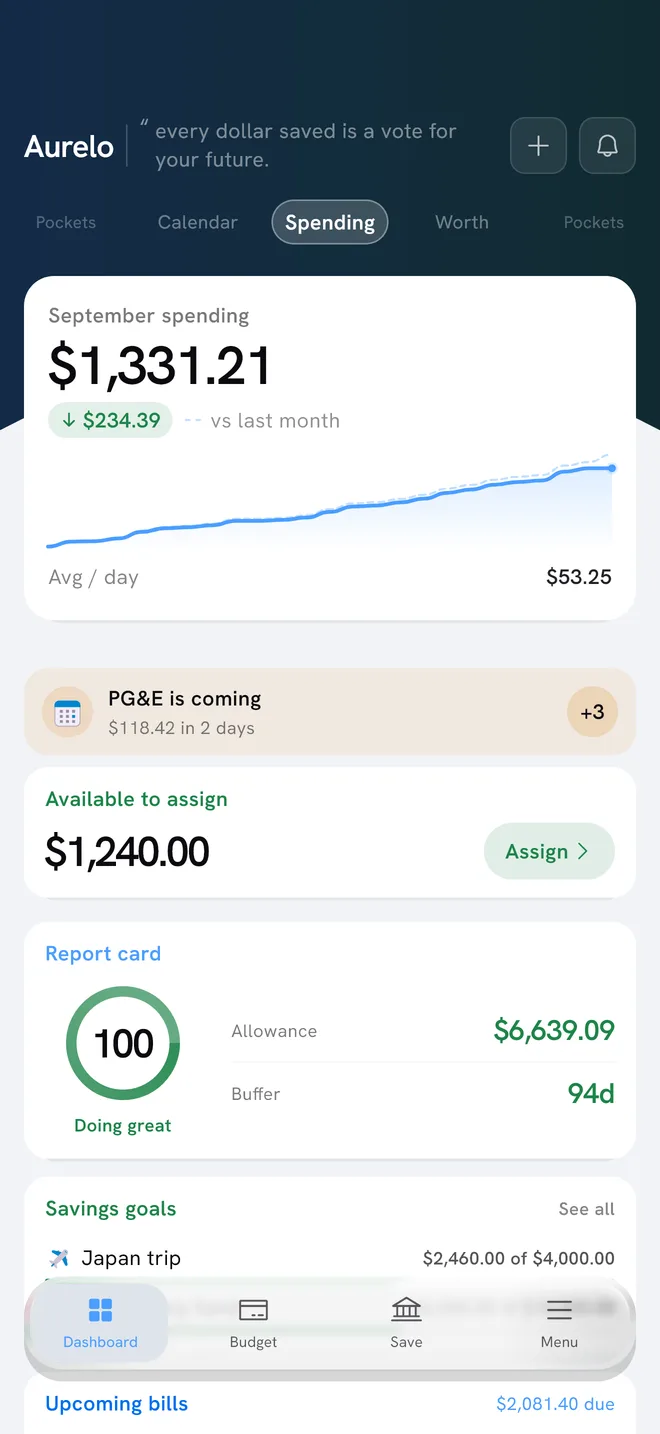
In Aurelo: Today’s Allowance shows what you can spend today: your checking balance, minus the bills due before your next payday, minus what your pockets still need. If it turns red, you’re spending tomorrow’s money, and Aurelo offers a Reshuffle to move money between pockets and get back on track.
Step 4: Plan the money that isn’t every month
Student life has a lot of costs that come once a term or once a year. They’re the ones that break a budget if you forget them:
- Textbooks and course fees
- Flights or gas home for breaks
- Holiday and birthday gifts
- Annual subscriptions, such as software or cloud storage
- Graduation, formal events or club dues
Set aside a small amount each month for these. A few dollars a week adds up to the flight home by December. Sinking funds explains how to size them.
Step 5: Build a small cushion
Young adults are less likely than older ones to have savings to fall back on. In the Federal Reserve’s survey of household finances in 2025, 37% of adults ages 18 to 29 said they had savings to cover three months of expenses, compared with 55% of all adults.2
Three months may be out of reach on a student budget, and that’s fine. Aim first for something small, like $300 to $500, enough to cover a phone screen, a textbook you didn’t expect, or a trip to urgent care without borrowing. How big should your emergency fund be? covers growing it later.
Using credit cards as a student
A credit card can help you build credit history, which matters when you rent an apartment or finance a car later. It can also turn a tight month into months of interest.
The rules that keep it safe are simple:
- Use it only for things already in your budget.
- Pay the full statement balance every month, not the minimum.
- Treat every card purchase as money already gone from your budget, even though the bill comes later.
That third rule is where most students slip, because the checking balance doesn’t drop when you swipe. How to budget when you pay with credit cards goes into more detail.
In Aurelo: With Card Cover, a credit card purchase comes out of the right pocket right away and is set aside for that card’s payment, so the bill is already covered when it’s due. Paying the card shows as a transfer, not new spending.
Watch the small recurring charges
Streaming, music, cloud storage, food delivery memberships, app subscriptions: at $5 to $15 each they’re easy to ignore, and they often start as free trials. On a student budget, five of them can equal a week of groceries. A quick way to catch them is to scan three months of statements for anything that repeats, then keep the ones you actually use.
Getting started tonight
- Write down the money you have for this term and when the next money arrives.
- Subtract lump costs, then divide what’s left by the months remaining.
- Fund rent, food, transport and phone first.
- Give yourself a steady weekly or monthly allowance from the rest.
- Set aside a little for breaks, books and a small cushion.
In Aurelo: Connect your checking account and cards read-only, and Aurelo reads your recent transactions and suggests pockets that match how you actually spend. If you’re just starting out and don’t have much history, you can pick pockets yourself, enter a starting amount and log spending by hand. Both work on the Free plan.
When you move off campus, the numbers change again. Your first apartment budget covers every cost to plan for.
Common questions
How much money does a college student need per month?
It depends heavily on whether you pay rent, have a meal plan and live in an expensive city. Add up rent, food, transport, phone, books and personal costs for the term, divide by the number of months, and that's your real monthly number. Your school's published cost of attendance is a useful cross-check.
How do I budget my financial aid refund?
Treat it as the money for the whole term. Subtract the costs you'll pay in lumps, like books and a deposit, then divide what's left by the months or weeks until the next disbursement. Pay yourself that amount at a steady rhythm instead of spending from the full balance.
Should college students have a credit card?
A card can help build credit history if you use it for planned purchases and pay the full statement balance every month. It becomes risky when it's used to cover gaps in the budget. If you get one, treat every purchase as money already spent.
What is the 50/30/20 rule for college students?
It splits take-home money into 50% needs, 30% wants and 20% savings. For many students, needs take a bigger share because income is low, so treat it as a rough guide and focus first on covering essentials and building a small cushion.
Sources
- Trends in College Pricing and Student Aid Report (2025) , College Board, 2025
- Economic Well-Being of U.S. Households in 2025: Savings and Investments , Federal Reserve Board, 2026
Written by the Aurelo team. We build Aurelo, a budgeting app that reads your accounts read-only and never moves your money. Every claim about the app is checked against the app itself, and every figure links to its source. This is general education, not financial, tax or legal advice.