Key takeaways
- Size the fund from essential costs only, not everything you spend in a normal month.
- Three to six months is a range; variable pay, one earner or dependents push it higher.
- Start with a reachable first goal, such as $1,000 or one month of essentials.
- Counting your cushion in days makes progress easier to see and act on.
An emergency fund is money set aside for the things you can’t schedule: a job loss, a car repair, a vet bill, a sudden trip home. It is not exciting money. Its whole job is to let a bad week stay a bad week instead of turning into months of card debt.
The hard part is the number. “Three to six months” is the answer you hear most, but three to six months of what? This guide walks through sizing the fund from your own costs, setting a first goal you can actually reach, where it usually makes sense to keep it, and a more useful way to measure it.
This is general education, not personal financial advice. Your situation decides the right size.
The rule of thumb, and what it assumes
A common rule of thumb is to hold three to six months of essential expenses. Two words in that sentence matter.
Essential means what you must pay to keep life running, not everything you spend today. In a real emergency most people stop eating out, pause shopping and delay trips. The fund only needs to cover what’s left.
Three to six is a range because situations differ. Some things that tend to push you toward the higher end:
- Income that varies month to month, such as freelance, commission or seasonal work (see budgeting on an irregular income)
- Being the only earner in the household
- Children or other people who depend on you
- A job in a field where finding new work can take a while
- An older car, an older home, or a health condition that makes big bills more likely
Things that can make the lower end reasonable: a stable job, two incomes where either could cover the essentials, and low fixed costs.
If three months sounds like a lot, it’s also a common place to be short of. The Federal Reserve’s household survey describes savings that would cover three months of expenses as a common measure of financial resilience, and in its survey of 2025, 55 percent of adults said they had set aside that much in an emergency or “rainy day” fund.1 Nearly half had not, so if you’re starting from zero, you’re in a lot of company.
Step 1: Find your essential monthly number
Go through the last two or three months of your bank and card statements and pull out only the costs you couldn’t easily pause. Use monthly amounts, and divide yearly bills by 12.
| Essential cost (example) | Monthly |
|---|---|
| Rent | $1,450 |
| Utilities and phone | $210 |
| Groceries (a lean version) | $450 |
| Car payment, insurance and gas | $520 |
| Health insurance and prescriptions | $180 |
| Minimum debt payments | $150 |
| Yearly bills, averaged (renters insurance, registration) | $40 |
| Essential total | $3,000 |
In this example, someone who spends $4,200 a month in normal life needs $3,000 a month to keep the lights on. That difference matters: three months of essentials is $9,000, while three months of everything would be $12,600.
A few tips while you add it up:
- Use a realistic grocery number, not your current one and not a fantasy one. What you would actually spend if money were tight.
- Include minimum payments on debts, since those don’t stop in an emergency.
- Don’t forget yearly bills. Car insurance or a registration renewal can land in the middle of a bad month. If you already set money aside for them, you can leave them out here. Sinking funds cover how.
- Leave out savings contributions. You would pause those too.
Step 2: Multiply by your months
With an essential number of $3,000 a month:
| Months covered | Target |
|---|---|
| 1 month | $3,000 |
| 3 months | $9,000 |
| 6 months | $18,000 |
That is the whole “emergency fund calculator”: essentials times months. The tricky part is getting an honest essential number, not the arithmetic.
Step 3: Start with a goal you can reach
A target like $9,000 or $18,000 can feel so far away that it stops you starting at all. It helps to break the fund into stages.
- A starter cushion. Many people start with around $1,000, or one month of essentials. This covers the most common surprises (a tire, a copay, a broken phone) without reaching for a card. It’s a meaningful line: in the same 2025 survey, 63 percent of adults said they would cover a $400 emergency expense entirely with cash, savings or a card paid off at the next statement.1 A $1,000 cushion puts you comfortably on the right side of that question.
- One month of essentials. Now a short gap in pay isn’t an immediate crisis.
- Your full target. Three to six months, or whatever fits your situation.
As an example, setting aside $250 a month reaches a $1,000 starter cushion in four months. Some months you may manage more and some less, and that is fine. What matters most is that the fund keeps moving in one direction. Setting the amount aside as soon as you’re paid, before other spending, helps; pay yourself first explains the habit.
If you are paying off high-interest debt at the same time, a common pattern is: starter cushion first, then focus on the debt, then build the rest of the fund. The cushion stops new surprises from landing on the card you are trying to pay down.
If most months feel like they end with nothing left, start with living paycheck to paycheck before worrying about a big target. Even a small cushion changes how a surprise feels.
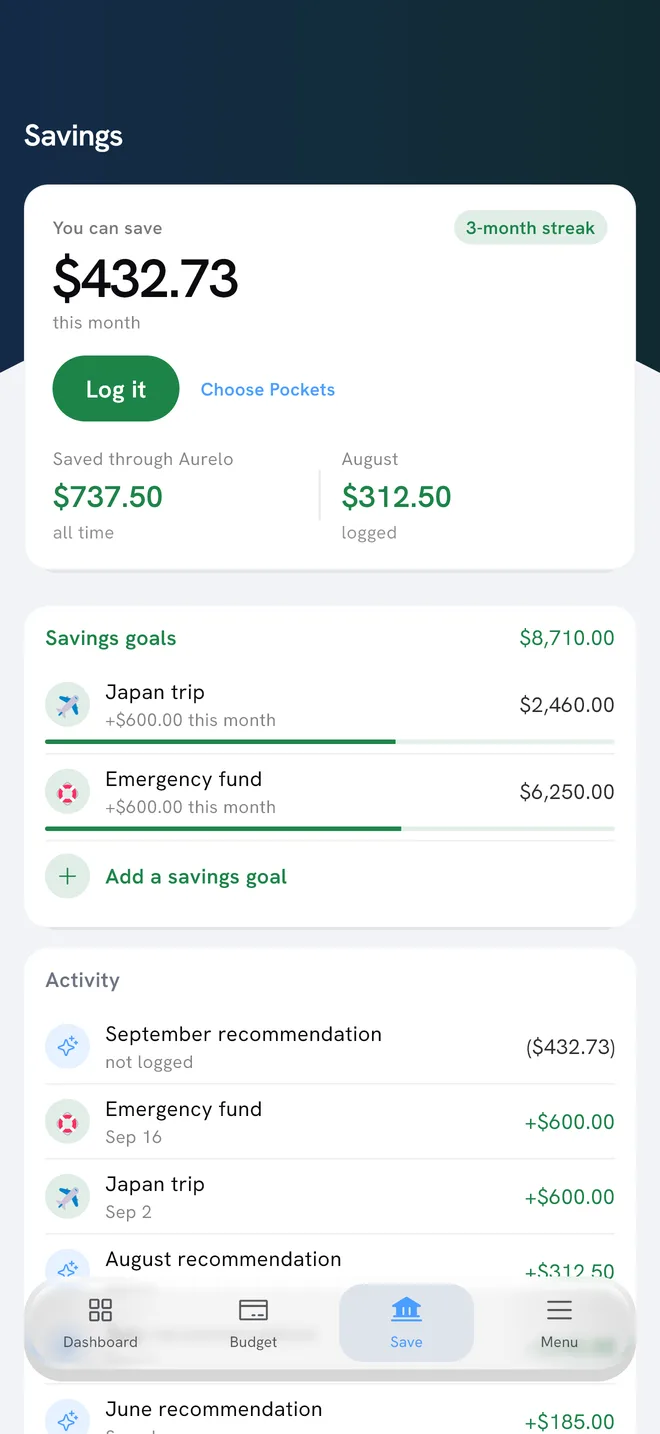
In Aurelo: Make a savings goal called “Emergency fund” with your target, and it shows your progress toward it. The Save tab shows what you can save this month after your pockets and the bills still ahead. You move the money yourself in your bank, then tap Log it so Aurelo keeps the running total.
Where it’s reasonable to keep it
This is general guidance, not a product recommendation. Most people look for three things.
Separate from your spending money. If the fund sits in your checking account, it tends to get spent without anyone deciding to spend it. A separate savings account, even at the same bank, adds a small, useful bit of friction.
Easy to reach. You should be able to get to the money within a day or two without penalties. An emergency fund you can’t touch quickly isn’t doing its job.
Not invested in things that swing in value. Emergencies often arrive at the same time as a downturn, such as a layoff during a weak market. Money that could be down when you need it is a poor fit for this particular job. A plain savings account at a bank or credit union is the usual home.
It’s also worth deciding in advance what counts as an emergency. A simple test: is it necessary, is it urgent, and was it unexpected? A yearly insurance bill fails the “unexpected” test, which is why it belongs in its own sinking fund.
Measure it in days, not months
“Three months” is a useful target, but it is hard to feel. Days are easier. If your cash would cover 45 days of normal life, you know exactly how much room you have.
To estimate your own number:
- Add up the cash you could use: checking plus savings.
- Work out your average daily spending over the last 30 days: total spending divided by 30.
- Divide the first by the second.
For example, $6,000 in checking and savings, with $3,600 of spending in the last 30 days ($120 a day), comes to 50 days.
This number moves in ways that are easy to act on. Spending a little less in a month raises it. Adding to savings raises it. A spending-heavy month lowers it, and you see that right away instead of at the end of the year.
A rough way to read it:
- Under 14 days: a surprise bill is likely to cause real stress. Building a starter cushion is the first priority.
- 14 to 29 days: some room, but a bigger surprise would still hurt.
- 30 days or more: a genuine cushion, and a good point to work toward your full target.
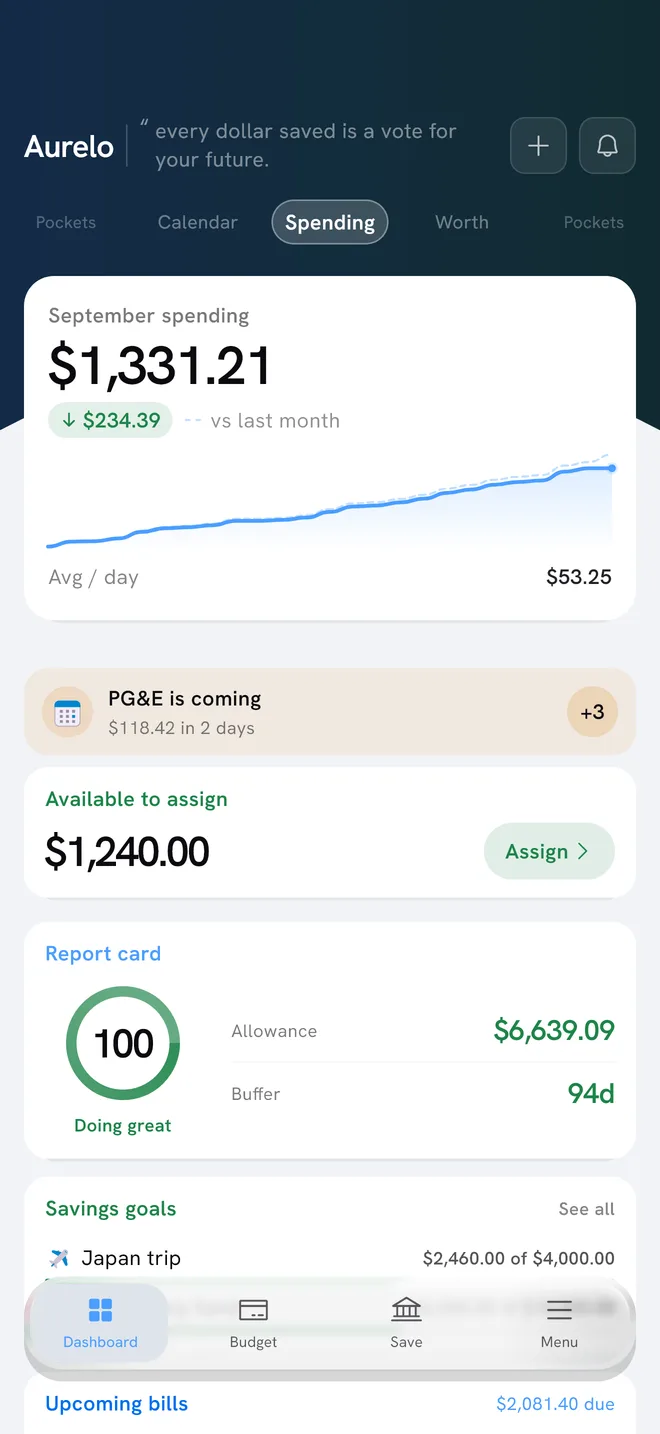
In Aurelo: This is what Buffer Days shows: how many days your checking and savings would last at your average daily spending over the last 30 days. Under 14 days shows red, 14 to 29 yellow, and 30 or more green. It sits on your dashboard’s Report card, next to Today’s Allowance.
When you use it, refill it
Using your emergency fund is not a failure. It means the fund did exactly what it was built for. Afterwards, go back to Step 3: treat the refill like a new starter goal and rebuild at whatever pace your budget allows. If you’re unsure what pace is realistic, what counts as a good savings rate gives some reference points.
If you use it more than once or twice a year for the same kind of cost, that cost probably isn’t an emergency. Car maintenance, annual bills and holiday spending are predictable, even if irregular, and are easier to handle as their own planned amount in your budget. See how to make a budget for where those fit.
The short version
- Add up your essential monthly costs.
- Multiply by three to six months, depending on how steady your situation is.
- Start with a smaller first goal, such as $1,000 or one month.
- Keep it separate, easy to reach, and out of anything volatile.
- Watch it in days so you always know how much room you have.
Common questions
How many months of expenses should be in an emergency fund?
A common rule of thumb is three to six months of essential expenses. Toward three can suit a steady job and a second income in the home; toward six or more suits variable pay, one earner, or dependents.
Should I pay off debt or build an emergency fund first?
Many people do both in stages: a small starter cushion first so a surprise doesn't go on a card, then extra money toward high-interest debt, then the full fund. The right order depends on your situation, so treat this as a general pattern, not a rule.
Where should I keep my emergency fund?
Somewhere separate from your everyday spending, easy to reach within a day or two, and not invested in anything whose value swings. A plain savings account at a bank or credit union is the usual choice.
How do I calculate my emergency fund number?
Add up what you must pay each month to keep life running (housing, utilities, groceries, insurance, minimum debt payments, transport) and multiply by the number of months you want covered. Leave out spending you would pause in a crisis.
Sources
- Economic Well-Being of U.S. Households in 2025: Savings and Investments , Federal Reserve Board, 2026
Written by the Aurelo team. We build Aurelo, a budgeting app that reads your accounts read-only and never moves your money. Every claim about the app is checked against the app itself, and every figure links to its source. This is general education, not financial, tax or legal advice.