Key takeaways
- Moving in usually costs two to three times the monthly rent before you've bought a single plate.
- The Census Bureau counts rent above 30% of income as a cost burden; use that as a warning line.
- Your monthly budget is rent plus utilities, internet, insurance and the everyday costs you used to share or skip.
- Keep a separate cushion for the first few months, when surprise costs are most likely.
Your first apartment is a big step, and the rent is only part of the bill. Before you get the keys you’ll usually pay a deposit, fees and the first month’s rent. Then there’s the truck, the mattress, the shower curtain, the utility setup, and a steady stream of small things you didn’t know you’d need.
None of this is hard to plan for once you can see it all in one place. This guide lists every cost to budget for, walks through a worked example, and shows how to set up a monthly budget that holds after the move.
Start with how much rent you can carry
Before you plan the move, check that the rent fits. The Census Bureau considers a renter household cost-burdened when it spends more than 30% of its income on rent, and severely cost-burdened above 50%.1 In the Census Bureau’s 2023 data, 49.7% of renter households were over that 30% line.1
For context, the median gross rent in the U.S. was $1,487 in 2024, and the median renter spent 31% of their income on rent.2 Your local market may be well above or below that.
A quick check: multiply your monthly gross income by 0.3. If you earn $4,500 a month before taxes, that’s $1,350. Staying at or below that leaves room for everything else in this guide. How much rent can I afford? goes deeper, including how debts and take-home pay change the answer.
The up-front costs
These are the costs you pay before or right around move-in day. Not every apartment has all of them, and amounts vary a lot by city and landlord, so treat this as a checklist.
- Application fees. Charged per applicant for credit and background checks. You may pay more than one if you apply to several places.
- Security deposit. Often around one month’s rent, though limits and rules vary by state. It’s refundable, minus any damage, when you move out.
- First month’s rent. Due at signing or on move-in. Some landlords also ask for the last month’s rent up front.
- Broker or move-in fees. Common in some cities, rare in others. Ask before you apply.
- Pet deposit or fee. If you have a pet, often with monthly pet rent too.
- Moving costs. A truck or van rental, gas, moving help, boxes and supplies.
- Utility setup. Some electric, gas or water providers charge a connection fee or a deposit for new customers, especially without a credit history.
- Internet setup. Installation or equipment fees.
- Renter’s insurance. The first payment, if the policy is paid monthly, or the full year up front.
- Furniture and basics. A bed, somewhere to sit, a table, lamps, curtains, kitchen basics, towels, cleaning supplies, a first big grocery shop.
A worked example
Here’s an example for a one-bedroom at $1,350 a month, moving across town:
| Up-front cost (example) | Amount |
|---|---|
| Application fee | $50 |
| Security deposit (one month) | $1,350 |
| First month’s rent | $1,350 |
| Truck rental, gas and supplies | $250 |
| Utility and internet setup | $100 |
| Renter’s insurance, first month | $15 |
| Mattress and bed frame | $500 |
| Other furniture (secondhand where possible) | $400 |
| Kitchen, bath and cleaning basics | $300 |
| First big grocery shop | $150 |
| Total up front | $4,465 |
In this example, moving in costs more than three times the monthly rent. That’s typical of why first apartments feel expensive: the costs arrive all at once, weeks before the first normal month.
A few ways people bring this down:
- Buy furniture in stages. A bed and a place to eat in week one; the rest over a few months as your budget allows.
- Go secondhand. Tables, shelves, dressers and kitchenware are often cheap or free locally.
- Ask friends to help move instead of hiring movers, and time the move for a weekday if the truck is cheaper.
- Ask about the deposit. Some landlords take a smaller deposit with good credit or a co-signer.
The monthly costs
Once you’re in, your monthly budget includes everything a parent, a dorm or former housemates may have been covering.
| Monthly cost (example) | Amount |
|---|---|
| Rent | $1,350 |
| Electricity and gas | $110 |
| Water, trash, sewer (if not included) | $50 |
| Internet | $60 |
| Phone | $45 |
| Renter’s insurance | $15 |
| Groceries | $400 |
| Transport | $180 |
| Household supplies and toiletries | $50 |
| Essentials total | $2,260 |
On a take-home pay of $3,500 a month, that leaves $1,240 for eating out, fun, clothes, subscriptions, debt payments and saving. Knowing that number before you sign the lease is the whole point of this exercise.
Some costs will be new, and they’re easy to underestimate:
- Utilities change with the seasons. Heating and cooling can swing the bill a lot. Ask the landlord or previous tenant what winter and summer bills looked like.
- Household basics add up. Toilet paper, dish soap, light bulbs, trash bags. Budget a small monthly amount.
- Yearly costs appear. Renter’s insurance if paid annually, a parking permit, renewing your lease with a rent increase. Set aside a little each month; sinking funds shows how.
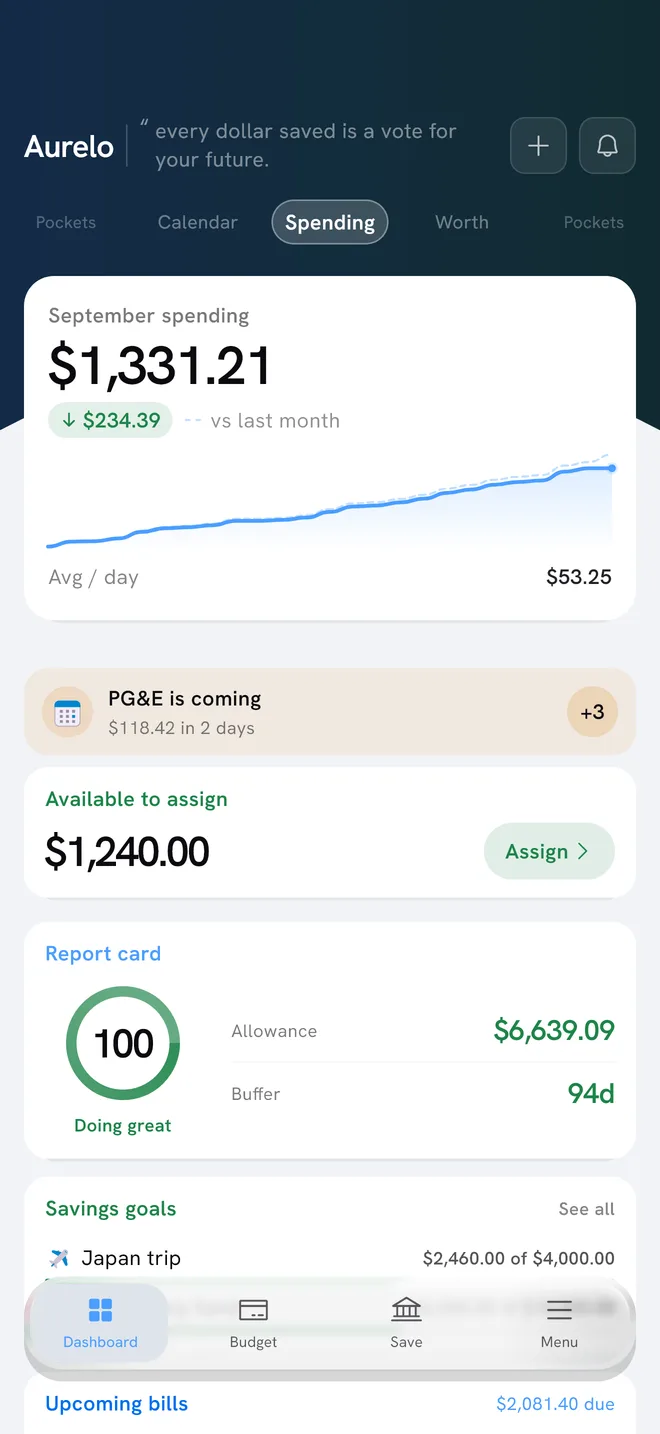
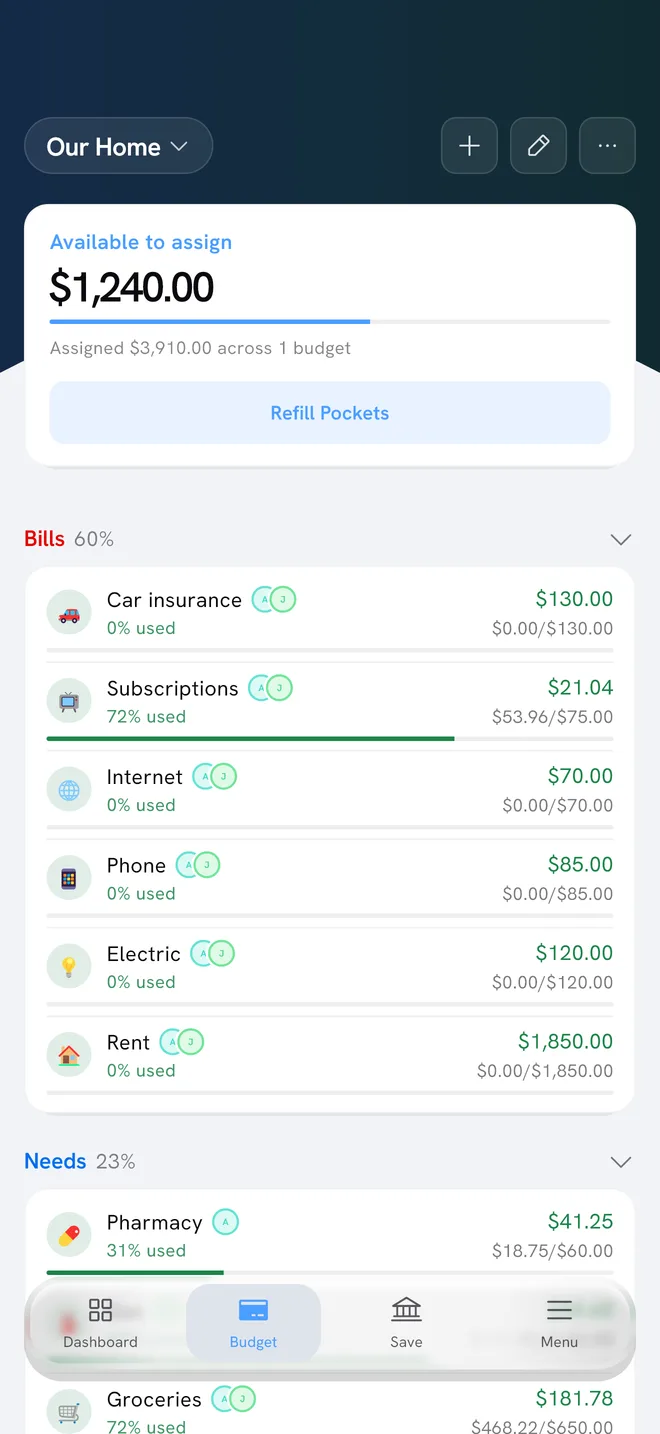
In Aurelo: Your budget is built from pockets grouped as Bills, Needs and Wants. Rent, utilities and internet sit in Bills, groceries and transport in Needs, and eating out and fun in Wants, each showing what’s left this month. Aurelo also detects recurring bills from your transactions and shows what’s due and when.
Keep a cushion for the first few months
The first months in a new place come with surprises: a missing shower rod, a utility bill higher than expected, a lock that needs replacing, a deposit that took longer to come back from the old place. A cushion stops those from going on a card.
A reasonable target before moving is at least one month of your essential costs, held separately from the move-in money. Over time, grow it toward a full emergency fund; see how big your emergency fund should be.
In Aurelo: Buffer Days shows how many days your checking and savings would last at your average daily spending over the last 30 days. In the first months after a move, when spending runs high, it’s a quick way to see how much room you really have.
Moving in with roommates or a partner
Sharing a place can cut both the up-front and the monthly costs sharply, but it adds one job: agreeing who pays what, and when. Before you move in, decide:
- How rent is split (evenly, or by room size or income).
- Which bills are shared, and whose name each one is in.
- How shared groceries and household supplies work.
- What happens if someone moves out early.
Writing it down avoids most of the awkward conversations later. How to budget as a couple covers splitting methods that also work for housemates.
In Aurelo: You can share a budget with a housemate or partner by inviting them through their Aurelo account. Each person chooses which of their own accounts feed the shared budget, and accounts you don’t link stay private. On the Free plan you can collaborate with one other person.
Your first-apartment checklist
- Check that rent is at or under about 30% of your gross income.
- Add up the up-front costs: fees, deposit, first month, moving, setup, basics.
- Build the monthly budget, including utilities, insurance and supplies.
- Save a cushion of at least one month’s essentials on top of the move-in money.
- Buy furniture in stages and secondhand where you can.
- If sharing, agree the split in writing before you sign.
If you’re still in school, budgeting for college students covers planning around semesters and aid refunds, which pairs well with this list.
Common questions
How much money should I save before moving into my first apartment?
Plan for the move-in costs (often first month's rent plus a deposit and fees), moving and basic furniture, plus a cushion of at least one month's living costs. For many first apartments that adds up to roughly three to four times the monthly rent. Build your own number with the checklist in this guide.
What costs are there when you move into an apartment?
Up front: application fees, a security deposit, the first month's rent (sometimes last month's too), moving costs, utility setup, renter's insurance and basic furniture and household items. Monthly: rent, utilities, internet, phone, insurance, groceries, transport and everything else you'll now pay for yourself.
What percentage of my income should go to rent?
A widely used guideline is no more than 30% of your gross income, which is also the line the government uses to define a housing cost burden. Many people aim lower if they have debts or want to save faster.
Is renter's insurance required?
It depends on the lease. Many landlords require it, and even when they don't, it's usually an inexpensive way to protect your belongings and cover liability. Check your lease and get a quote before you sign.
Sources
- Nearly Half of Renter Households Are Cost-Burdened, Proportions Differ by Race , U.S. Census Bureau, 2024
- The Cost of Homeownership Continues to Rise (2024 American Community Survey 1-year estimates) , U.S. Census Bureau, 2025
Written by the Aurelo team. We build Aurelo, a budgeting app that reads your accounts read-only and never moves your money. Every claim about the app is checked against the app itself, and every figure links to its source. This is general education, not financial, tax or legal advice.