Key takeaways
- The envelope method works because each spending area has a hard limit you can see shrink.
- You can keep that limit without cash by tracking a running balance for each spending area.
- Only a few flexible areas need envelopes; fixed bills can stay on autopay.
- When one envelope runs dry, move money from another on purpose instead of borrowing from next month.
The cash envelope method is one of the oldest budgeting tricks there is. On payday you take out cash, split it into labeled envelopes (groceries, gas, eating out), and spend only what is inside. When the grocery envelope is empty, grocery shopping is over until the next refill.
It works because it is physical. You can feel the envelope getting thinner. There is no “I’ll sort it out later” when there is nothing left to hand the cashier.
The problem is that most of life no longer runs on cash. This guide covers why the method works, what it looks like when your money lives on cards and phones, and how to set it up in an evening.
Why the envelope method works
Most budgets fail in the middle of the month, not on the day you make them. You write a sensible plan, then spend from one big checking balance that doesn’t tell you which part of it is already promised to rent or groceries. The number looks fine right up until it isn’t.
Envelopes fix that with three simple rules:
- Every spending area has a fixed amount. Groceries get $600 this month, not “whatever it takes”.
- You can see what’s left before you buy. The balance is right there in your hand.
- Running out is a real stop. You can’t spend from an empty envelope without a deliberate choice to take from another one.
None of those rules need paper money. They need a limit, a visible balance and a moment of friction when you go over. That is the part worth keeping.
Why cash alone is harder now
Paying for everything in cash has become awkward. In the Federal Reserve’s 2026 Diary of Consumer Payment Choice, people made about 47 payments a month, and only six of those were in cash.1 Debit and credit cards together made up two-thirds of all payments.1 Most people still carry a little cash, but only a little: in the same survey, 76% had cash on them, and the average amount was $69.1
That matters for an envelope system. Subscriptions, online orders, gas at the pump, rideshares and bills paid by app all bypass the envelopes entirely. Carrying large amounts of cash also has real costs: it can be lost or stolen, and it offers none of the fraud protection a card does.
So the question is not “cash or no cash”. It is how to keep envelope discipline when the money moves digitally.
The digital envelope method, step by step
1. Pick the areas that actually need a limit
Not everything needs an envelope. Fixed bills such as rent, insurance, your phone plan and loan payments cost the same every month and can run on autopay. The areas that drift are the flexible ones:
- Groceries
- Eating out and coffee
- Gas or transit
- Household and personal care
- Fun money or shopping
- Gifts
Five to eight envelopes is plenty for most people. More than that and you’ll spend your evenings moving pennies between them.
2. Set each amount from real spending
Look at the last two or three months of bank and card statements and total each area. Use that as your starting point, then decide whether to trim it. A limit you have never once lived within is a wish, not a plan.
3. Fund them on payday
With cash, you’d visit the ATM. Digitally, you “fill” each envelope by writing down its amount for the pay period. Here is an example for someone taking home $2,100 every two weeks, after rent and fixed bills are covered from the first paycheck of the month:
| Envelope (example) | Per paycheck | Per month |
|---|---|---|
| Groceries | $300 | $600 |
| Eating out | $90 | $180 |
| Gas | $80 | $160 |
| Household and personal | $60 | $120 |
| Fun money | $70 | $140 |
| Total flexible spending | $600 | $1,200 |
If you’re paid every two weeks, it often helps to fund envelopes per paycheck rather than per month, so the second half of the month isn’t living off what’s left of the first. See budgeting on a biweekly paycheck for how to line those up.
4. Subtract every purchase
This is the step that replaces the thinning envelope. Every card or phone payment gets taken off the right envelope’s balance. You can do it in a notes app, a spreadsheet, or a budgeting app that reads your transactions and sorts them for you. What matters is that you see “Groceries: $112 left” before you walk into the store, not three weeks later.
5. Treat an empty envelope as a decision point
With cash, an empty envelope stops you. Digitally, nothing stops you, so you need a rule. The rule most people use: if you want to spend from an empty envelope, you first move money into it from another one. Dinner out comes from fun money, not from next month.
That keeps the total honest. You can still be flexible, but every exception is visible and paid for.
6. Decide what happens to leftovers
At month’s end, some envelopes will have money left. Choose one approach and use it every time:
- Roll it over into the same envelope, useful for areas like gifts or clothing that come in lumps.
- Sweep it to savings, which turns careful weeks into progress.
- Send it to a goal, like a trip or paying down a card.
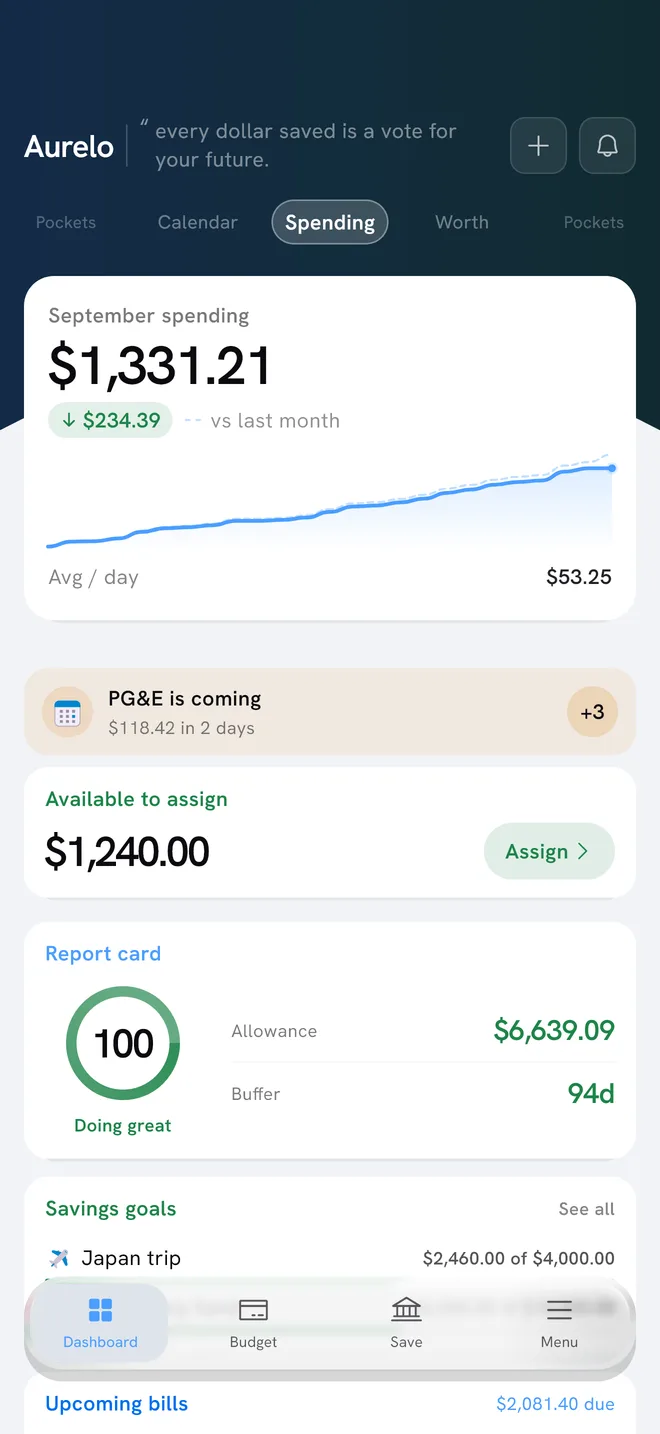
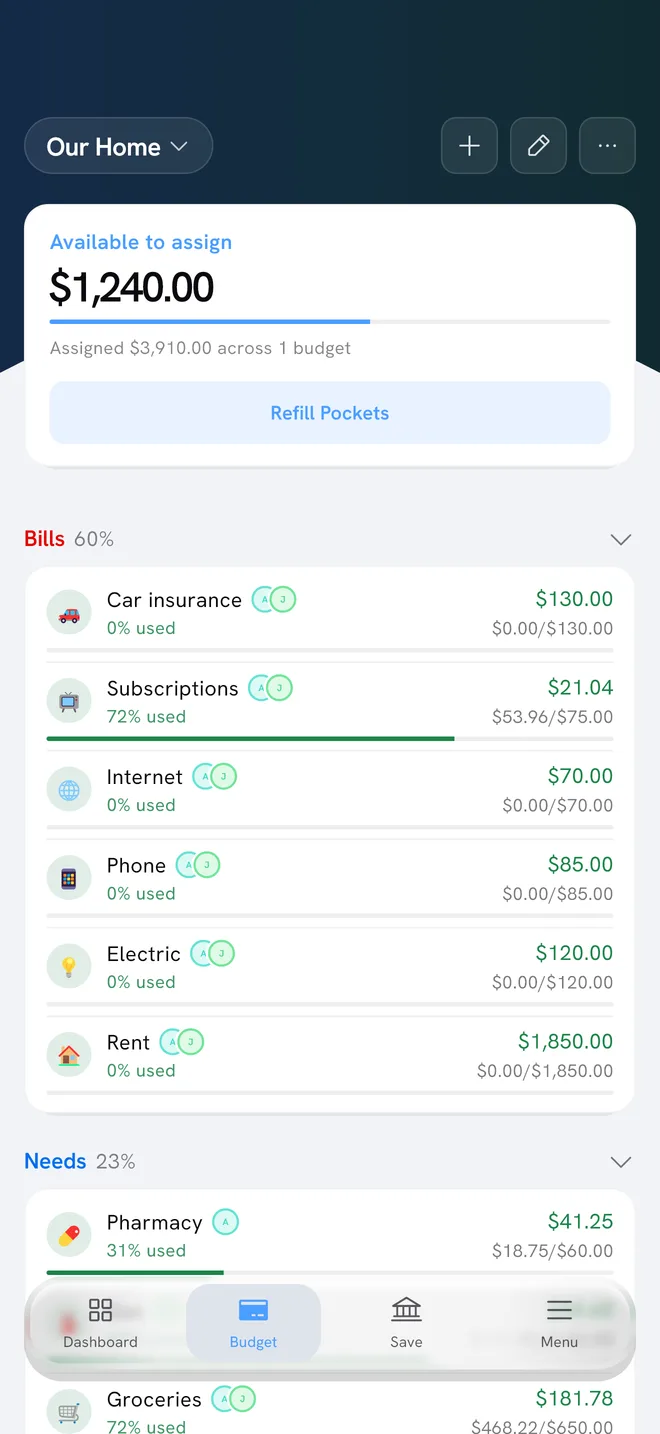
In Aurelo: The envelope method’s idea lives on as pockets. Your budget is split into pockets grouped as Bills, Needs and Wants, and each one shows what’s left: what you put in, minus what you’ve spent. Connect your bank read-only and Aurelo builds your pockets from how you actually spend, sorting purchases into the right one, or log spending by hand if you’d rather not connect. On Gold, new purchases keep arriving from your bank and file themselves.
Using credit cards without breaking the envelopes
Credit cards are where digital envelopes most often leak. A $90 grocery run on a card doesn’t leave your checking account until the bill is due, so your bank balance looks healthier than it really is.
The fix is to treat the card purchase as spent from the envelope the moment it happens. When the statement arrives, the money for it has already been set aside across your envelopes, and paying the card is just moving money you’d already committed. It is not new spending, and it shouldn’t be counted twice. There’s more on this in how to budget when you pay with credit cards.
In Aurelo: Card Cover handles this. When you buy something on a credit card, the amount comes out of the right pocket and is set aside for that card’s payment. Paying the card shows up as a transfer, not new spending, and the card shows its real balance.
Common mistakes
Too many envelopes. Splitting “food” into groceries, lunch, coffee, snacks and takeout sounds precise but becomes a chore. Merge anything under about $50 a month into a nearby envelope.
Forgetting irregular costs. Car registration, an annual subscription or holiday gifts can drain a normal envelope in one hit. Give yearly costs their own small monthly amount; sinking funds explains how.
Borrowing from next month. Taking tomorrow’s grocery money to cover today’s overspend feels harmless and snowballs quickly. Move money sideways between this month’s envelopes instead.
Checking too late. An envelope you look at once a week is a report, not a limit. The whole point is to see the balance before you buy.
Is it right for you?
The envelope method suits people who overspend in a few specific areas, who like firm limits, or who are coming off a stretch of card debt and want a clear rule. It also works well for couples and housemates, because a shared envelope for groceries or household supplies makes it obvious how much is left for everyone. Budgeting as a couple covers that setup.
If your spending is already steady and you mostly need to save more, a lighter approach may be enough. Either way, the principle underneath is the same one behind zero-based budgeting: decide where money goes before it’s gone.
In Aurelo: If a pocket runs over, Reshuffle lets you move money from another pocket to cover it, which is the digital version of borrowing from a different envelope. When you have money not yet in a pocket, it shows as Available to assign, and Refill Pockets tops them back up.
The short version
- Choose five to eight flexible spending areas.
- Give each a fixed amount based on real past spending.
- Fill them when you’re paid.
- Subtract every purchase, card or cash, as it happens.
- When one runs out, move money from another on purpose.
- Decide in advance what leftovers are for.
Common questions
Does the cash envelope method still work if I pay with a card?
Yes, if you keep the core rule: a fixed amount for each spending area and a balance you check before buying. The cash was only ever a way to make that balance visible. A running total per area does the same job.
What categories should I use for envelope budgeting?
Start with the flexible spending that tends to drift: groceries, eating out, gas, household supplies and personal spending. Rent, insurance and other fixed bills rarely need their own envelope because the amount doesn't change.
What happens to leftover money in an envelope at the end of the month?
You decide. Common choices are rolling it into the same envelope next month, moving it to savings, or sending it toward a goal. Pick one rule and stick with it so the leftovers don't quietly vanish.
Is the envelope method the same as zero-based budgeting?
They are close relatives. Zero-based budgeting plans every dollar of income on paper. The envelope method is one way to enforce that plan during the month, by giving each area a limited pool to spend from.
Sources
- 2026 Diary of Consumer Payment Choice , Federal Reserve Financial Services, 2026
Written by the Aurelo team. We build Aurelo, a budgeting app that reads your accounts read-only and never moves your money. Every claim about the app is checked against the app itself, and every figure links to its source. This is general education, not financial, tax or legal advice.