Key takeaways
- Couples usually choose between fully joint, fully separate, or a shared budget for shared costs only.
- When incomes differ a lot, splitting shared costs in proportion to income often feels fairer than 50/50.
- Agree on a check-with-me-first amount and keep some personal money that needs no explaining.
- A short monthly check-in keeps money talk routine instead of a crisis meeting.
Budgeting on your own is mostly a math problem. Budgeting with a partner is a math problem plus two sets of habits, two histories with money and, often, two very different ideas of what counts as a reasonable thing to spend on. In about half of married couples there are two paychecks to coordinate as well: in 2025, both spouses were employed in 49.1 percent of married-couple families, according to the Bureau of Labor Statistics.1 That is all normal. Most couples who argue about money are not arguing about the numbers. They are arguing because nobody ever agreed on how the money works.
This guide walks through the three common ways couples set up their finances, how to split shared costs fairly, and how to have the money conversation in a way that actually settles things.
The three common setups
There is no correct setup. There is only the one that fits how the two of you live, earn and trust each other. Here are the three most couples end up choosing between.
1. Fully joint
All income goes into shared accounts, and every expense comes out of them. There is one budget and one pool of money.
Works well when: you have similar attitudes to spending, you have been together a while, and you like simplicity. It is the easiest setup to track because there is only one picture.
Watch out for: feeling like you need permission for small personal purchases. Many joint couples fix this by giving each person a set amount of personal spending each month, no questions asked.
2. Fully separate
Each person keeps their own accounts and pays their own way. Shared costs get settled up, often by one person paying and the other paying them back.
Works well when: you are early in the relationship, you have very different incomes or debts, or one or both of you value independence highly.
Watch out for: nobody owning the shared picture. Rent gets paid, but nobody knows whether the two of you are saving anything together, and the “who owes whom” math can quietly build resentment.
3. Shared budget for shared costs, individual money for the rest
This is the middle path, and it is where a lot of couples land. You agree on which costs are shared (rent or mortgage, utilities, groceries, the car, joint savings goals) and plan those together. Everything else stays individual.
Works well when: you want to act as a team on the big stuff without reporting every coffee to each other. It also scales well as a relationship changes, because you can move costs in and out of the shared side over time.
Watch out for: fuzzy edges. Decide up front whether things like takeout together, gifts for family or a shared streaming service count as shared.
How to split shared costs
Once you know what is shared, you need to decide who pays how much. The two common approaches are an even split and a proportional split.
50/50 is simple and feels fair when incomes are close. Each person puts in half of the shared costs.
Proportional to income means each person contributes the same percentage of their take-home pay. When one partner earns noticeably more, this usually feels fairer, because the lower earner is not left with far less money of their own at the end of the month.
Unequal pay is the usual case, not the exception. Pew Research Center found that in 2022, husbands and wives earned about the same (each bringing in 40 to 60 percent of the couple’s combined earnings) in 29 percent of marriages.2 In most of the rest, one partner earns clearly more, which is exactly when the choice between these two approaches matters.
A worked example
Say you share these costs each month (example numbers):
| Shared cost | Monthly |
|---|---|
| Rent | $2,000 |
| Utilities and internet | $250 |
| Groceries | $700 |
| Car insurance and gas | $350 |
| Joint savings goal | $300 |
| Total | $3,600 |
Partner A takes home $5,000 a month. Partner B takes home $3,000. Combined, that is $8,000.
| 50/50 split | Proportional split | |
|---|---|---|
| Partner A contributes | $1,800 | $2,250 (62.5%) |
| Partner B contributes | $1,800 | $1,350 (37.5%) |
| Partner A has left | $3,200 | $2,750 |
| Partner B has left | $1,200 | $1,650 |
With a 50/50 split, Partner B spends 60% of their pay on shared costs while Partner A spends 36%. With the proportional split, both put in 45%. Neither approach is wrong, but seeing it laid out like this usually makes the choice obvious for a couple.
Some couples go one step further and split proportionally for bills but evenly for fun money, or cover shared costs proportionally and then give each person the same personal allowance. Whatever you choose, write it down so it is not relitigated every month.
Having the money conversation
The hardest part of budgeting as a couple is not the spreadsheet. It is the first honest conversation. A few things make it go better.
- Pick a calm moment. Not after a surprise bill, not late at night, not in the middle of a disagreement about something else.
- Start with what you each want. A house in three years, less stress at the end of the month, a trip (see how to save for a vacation), paying off a card. Shared goals make the rules feel like a plan instead of a restriction.
- Share the whole picture. Income, debts, regular bills and anything you are worried about. If your bills are scattered, how to organize your bills helps you get them on one list first. Surprises later do more damage than awkward honesty now.
- Agree on a “check with me first” number. For example, any single purchase over $200 gets mentioned before it happens. This one rule prevents a lot of arguments.
- Leave room for personal money. Each person should have some money that is genuinely theirs to spend without explaining it.
- Set a monthly check-in. Fifteen minutes to look at the month, adjust the plan and flag what is coming up.
If you have never built a budget before, start with the basics in how to make a budget and then decide together which parts are shared. If you both like the idea of a plan for every dollar, zero-based budgeting works just as well for two people as for one.
When things go over
Every budget runs over somewhere eventually. A grocery month runs high, the car needs tires, a friend’s wedding lands in the same month as a dental bill. The point of a shared budget is that you decide together how to cover it, rather than one person quietly absorbing it or both of you finding out later.
The simplest habit is to move money from a pocket that has room to the one that went over, and mention it at your next check-in. If the same pocket runs over three months in a row, the plan is wrong, not the person. Raise the amount and take it from somewhere else.
How a shared budget works in Aurelo
Aurelo is built around the middle-path setup, and it works for the other two as well.
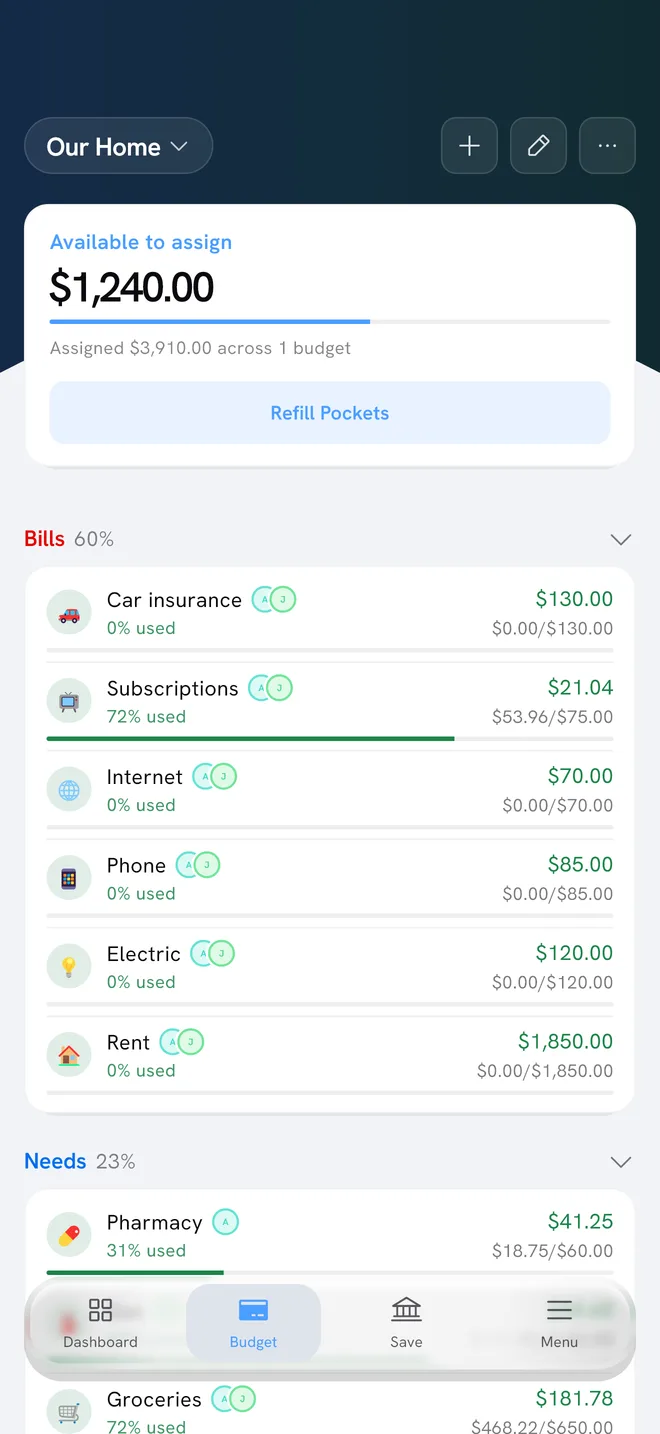
You create a budget and invite your partner by their Aurelo account. Each of you then chooses which of your own accounts feed that budget. If you link your checking account and your partner links theirs, the shared budget sees both. Any account you do not link stays private to you, so your personal card or savings never shows up in the shared view unless you decide it should.
In Aurelo: Sharing a budget is free. On the Free plan you can budget with one other person; on Gold, up to five people per budget. Everyone on the budget sees changes as soon as they open the app, so there is no emailing screenshots back and forth.
Inside the shared budget you plan the shared costs as pockets: rent, groceries, utilities, the joint savings goal. Spending from linked accounts is sorted into those pockets, and each pocket shows what is left for the month. If groceries runs over, either of you can use Reshuffle to cover it from another pocket, and the other person sees the change.
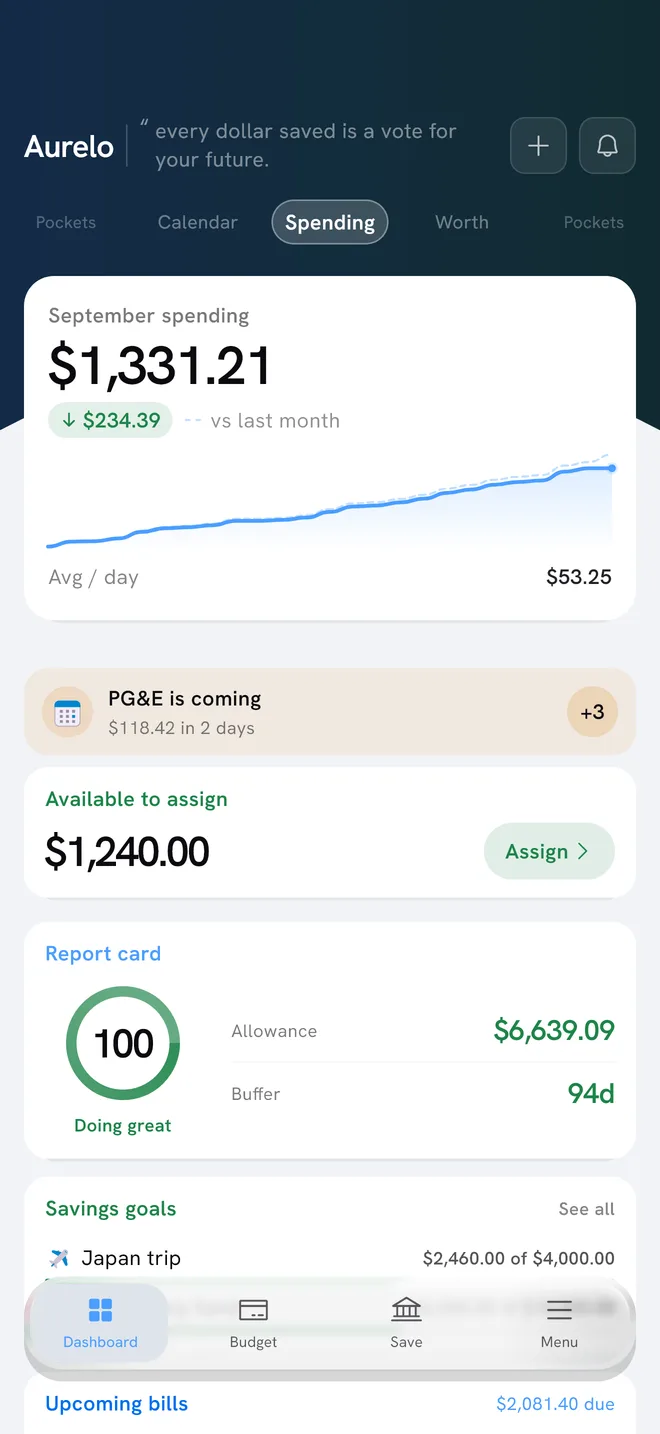
In Aurelo: A savings goal like “Emergency fund” or “Japan trip” shows progress toward its target. Aurelo never moves money itself: you move the money in your own bank, tap Log it, and Aurelo keeps the running total.
If one of you mainly pays with credit cards, it is worth reading how to budget when you pay with credit cards, since card spending is where shared budgets most often get confusing. For the step-by-step on inviting someone, see how to share a budget in Aurelo.
The short version
Pick the setup that fits your relationship right now, not the one you think you are supposed to have. Decide which costs are shared, split them in a way you both think is fair, and put that decision in writing. Keep some money that is yours alone. Then check in once a month, briefly, and adjust. Couples who budget well are not the ones who never disagree about money. They are the ones who agreed on how to handle it when they do.
Common questions
Should couples combine their finances?
There is no single right answer. Fully joint money works well for some couples and badly for others. Many couples do best with a middle path: a shared budget for the costs you share, and money of your own for everything else.
Is it fair to split bills 50/50 if one partner earns more?
It can be, if both of you can comfortably afford your half. When incomes are far apart, splitting in proportion to income often feels fairer, because each person gives up the same share of their pay rather than the same dollar amount.
How often should couples talk about money?
A short check-in once a month is enough for most couples. Look at what came in, what went out, and whether anything big is coming up. Keeping it regular and brief makes it routine instead of a crisis meeting.
Do we need a joint bank account to budget together?
No. You can share a budget while keeping separate accounts. What matters is agreeing on which costs are shared, how each of you contributes, and having one place where you can both see the plan.
Sources
- Employment Characteristics of Families--2025 , U.S. Bureau of Labor Statistics, 2026
- In a Growing Share of U.S. Marriages, Husbands and Wives Earn About the Same , Pew Research Center, 2023
Written by the Aurelo team. We build Aurelo, a budgeting app that reads your accounts read-only and never moves your money. Every claim about the app is checked against the app itself, and every figure links to its source. This is general education, not financial, tax or legal advice.