Key takeaways
- Your balance isn't your spending money: subtract the bills due before payday and your essentials first.
- A first buffer of a few hundred dollars can absorb one surprise without a late fee or overdraft.
- Moving a few due dates to just after payday can ease the end-of-month squeeze.
- Measure progress in days of cushion, even when your income hasn't changed.
If you are living paycheck to paycheck, you already know the feeling: checking your balance before buying groceries, doing math in your head at the gas pump, hoping a bill does not hit before your pay does. It is exhausting, and it is far more common than most people say out loud. In the Federal Reserve’s survey of 2025, 63 percent of adults said they would cover a $400 emergency expense entirely with cash, savings or a credit card paid off at the next statement, which leaves more than a third who would need some other way to pay.1 It happens on small incomes and on good ones, because rent, childcare, debt and surprise costs have a way of using up whatever comes in.
This is not an article about cutting out lattes. It is about getting a clear, calm view of the next couple of weeks, then building a little room, one paycheck at a time. It starts with three numbers.
The three numbers that matter most
When money is tight, a monthly budget can feel abstract. What you actually need to know is simpler and more immediate.
1. What’s due before your next payday
List every bill and payment that will leave your account between today and the day your next paycheck lands. Rent, the car payment, the phone bill, a card minimum, a subscription that renews on the 18th. Include the exact dates.
This is your first priority, because it is money that is already spoken for. Most overdrafts happen not because someone overspent in general, but because a bill landed a few days before the paycheck that was supposed to cover it.
2. What’s actually safe to spend today
Your bank balance is not what you can spend. It is what you have before the bills above come out. The number that matters is:
Checking balance − bills due before payday − what you still need for essentials like groceries and gas = safe to spend
Example: Your checking balance is $1,150 and your next paycheck is in nine days. Before then you owe $600 in rent, a $65 phone bill and a $40 card minimum, for $705. You also need about $250 for groceries and gas until payday. That leaves $195 that is genuinely safe to spend over the next nine days, or a bit over $20 a day.
That is a very different number from $1,150, and it is the one to look at before you buy something.
3. How many days of cushion you have
Take your total cash (checking plus any savings) and divide it by what you typically spend in a day. If you spend about $100 a day on average and have $600 in cash, you have about six days of cushion.
This number tells you how much room you have if a paycheck is late or something unexpected happens. When you are paycheck to paycheck, it is often under a week. The goal is to push it up, slowly, over time.
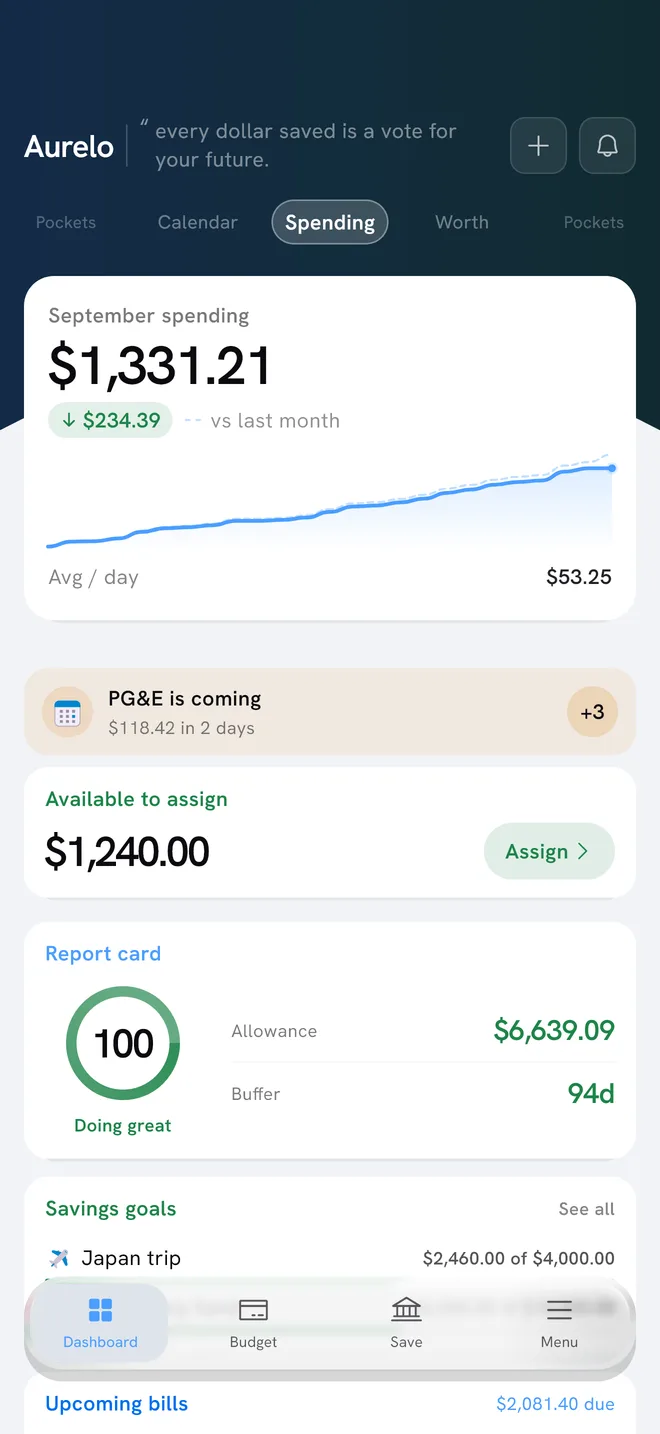
In Aurelo: Today’s Allowance is the second number, worked out for you: your checking balance, minus the bills due before your next payday, minus what your pockets still need. If it goes negative, it turns red and offers a Reshuffle so you can cover the gap from another pocket. Buffer Days is the third number: how many days your cash would last at your average spending over the last 30 days.
Build a small first buffer
A full emergency fund of several months of expenses can feel impossible from where you are. So do not start there. Start with a buffer big enough to absorb one surprise without a late fee or an overdraft.
A common first target is somewhere between $300 and $1,000, depending on what your usual surprises cost. Even $200 changes how a flat tire or a copay feels.
Ways to find the first few hundred dollars:
- Save a small, fixed amount each payday. $20 or $25 is fine. The habit matters more than the amount at first.
- Keep any windfall. A tax refund, a birthday check, a refund from a return: put it straight into the buffer before it gets absorbed.
- Sell one or two things you no longer use.
- Look at recurring charges. Sometimes a forgotten subscription or two turns up. See how to find every subscription you’re paying for.
Keep the buffer somewhere separate from your everyday checking so it is not accidentally spent, but easy to reach when you really need it. Once it covers one surprise, keep building toward one full month of expenses. The article on how big your emergency fund should be covers the longer-term target.
Time your bills to your paydays
This is one of the most effective and least talked-about fixes. Often the problem is not that you earn too little for your bills, but that the bills all land in the wrong week.
Example: You are paid on the 1st and the 15th. Rent ($1,200) is due on the 1st, but your car payment ($350), card minimum ($60) and insurance ($140) are all due between the 10th and the 14th. The first paycheck has to stretch across almost two weeks and four bills, while the second one arrives after they are all paid.
Fixes worth trying:
- Ask to move due dates. Many lenders, card issuers and utilities will let you choose a due date. Moving a few bills to the 16th or 17th can balance the two halves of the month.
- Split your pay by bill date. When a paycheck lands, immediately set aside the money for the bills due before the next one. If you are paid every two weeks, budgeting a biweekly paycheck shows how to match each check to its bills.
- Know which bills are flexible. Some bills allow a short grace period; others charge a fee the next day. Pay the ones with real consequences first.
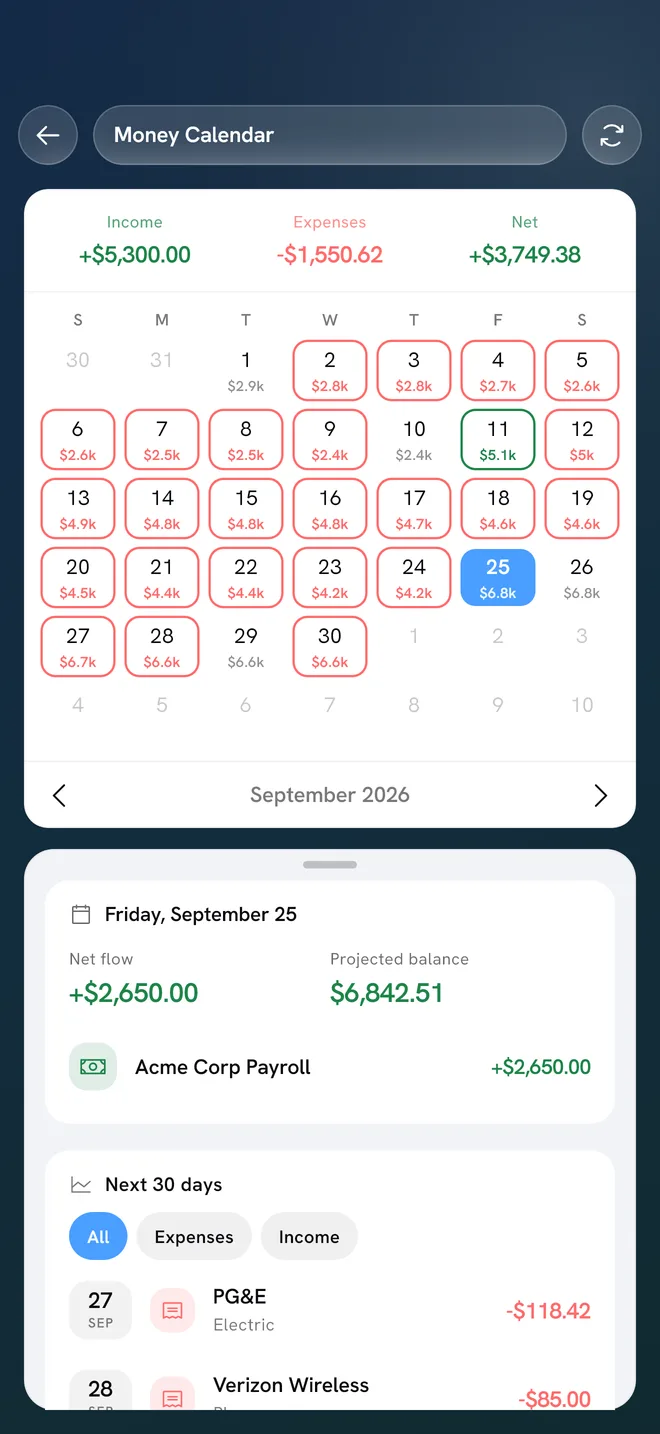
In Aurelo: The Money Calendar shows your month day by day: the income coming in, the bills going out, and a projected balance for each day. It makes it easy to spot the one week where everything collides, which is exactly the week worth rearranging. It is free on every plan.
Avoid the overdraft spiral
An overdraft fee is rarely a one-time event when money is tight. One fee makes the balance lower, which makes the next charge more likely to overdraw too, and a single short week can turn into several fees. Those fees add up across the country: the CFPB reported that consumers paid over $5.8 billion in overdraft and non-sufficient-funds fees in 2023, and that some banks still charged as much as $37 per overdraft.2 How to avoid overdraft fees goes deeper on the settings and habits that help.
A few ways to protect yourself:
- Know what is scheduled. Autopays are convenient but can surprise you. Keep a list of what comes out and when.
- Look at your safe-to-spend number, not your balance, before any purchase in the days before payday.
- Check your bank’s overdraft settings. Many banks let you choose whether a card purchase is declined or allowed into overdraft. It is worth knowing which one you have.
- Call before a bill is late, not after. Many companies will move a due date or set up a payment plan if you ask ahead of time.
- Be careful with high-cost short-term borrowing. It can cover one gap but make the next one wider.
If a credit card is carrying you through the gaps, budgeting when you pay with credit cards explains how to keep card spending from quietly outgrowing your plan.
Then build a simple budget
Once you can see the next two weeks clearly, a full budget becomes much less intimidating. Group your spending into bills, needs and wants. Plan each paycheck’s money before it is spent. Leave room for small pleasures, because a plan with none in it rarely lasts. How to make a budget walks through it step by step.
In Aurelo: Connect your checking account and cards, read-only, and Aurelo sorts your last six months of spending into suggested pockets, grouped as Bills, Needs and Wants. You can adjust anything. Or skip the bank entirely, pick your pockets, and log spending by hand.
Progress is measured in days
You probably will not go from paycheck to paycheck to comfortable in one month, and that is fine. Watch the third number. Going from four days of cushion to ten, then to thirty, is real progress, even if your income has not changed at all. Every day of cushion is a day where a late paycheck or a surprise bill is an inconvenience instead of a crisis.
Common questions
How do I stop living paycheck to paycheck?
Start small. Know what is due before your next payday, spend only what is left after that, and build a first buffer of even a few hundred dollars. Each week of cushion you add makes the next month less stressful.
How much should my first emergency buffer be?
A common first goal is enough to cover one unexpected bill without a late fee or overdraft, often somewhere between $300 and $1,000. It does not need to be a full emergency fund to make a real difference.
Can I change my bill due dates?
Often, yes. Many lenders, utilities and card issuers let you pick or move a due date if you ask. Moving bills to just after your paydays can remove a lot of the end-of-month squeeze.
Is it normal to live paycheck to paycheck?
It is very common, including for people with decent incomes. Rent, childcare, debt and irregular costs can take most of any paycheck. It says more about costs and timing than about character.
Sources
- Economic Well-Being of U.S. Households in 2025: Savings and Investments , Federal Reserve Board, 2026
- Data Spotlight: Overdraft/NSF Revenue in 2023 Down More Than 50% Versus Pre-Pandemic Levels , Consumer Financial Protection Bureau, 2024
Written by the Aurelo team. We build Aurelo, a budgeting app that reads your accounts read-only and never moves your money. Every claim about the app is checked against the app itself, and every figure links to its source. This is general education, not financial, tax or legal advice.