Key takeaways
- When money is tight, pay in order of consequence: housing, utilities, food, and getting to work come first.
- Plan by paycheck, not by month, so every bill is matched to the money that will actually pay it.
- A buffer of even $100 to $300 stops small surprises from turning into fees and debt.
- Screening for benefits is part of budgeting, and the government's free benefit finder at USA.gov is a good place to start.
Most budgeting advice quietly assumes there is some slack to work with: trim the takeout, redirect the savings, done. When your income barely covers the basics, that advice can feel like it was written for someone else. It wasn’t written for you, and that isn’t a failure on your part.
You are also far from alone. The Census Bureau counted 34.5 million people living below the official poverty line in 2025, a rate of 10.2 percent, and many more households sit just above it.1 A budget on a small income is a different tool. It is less about finding money to save and more about making sure the money you have lands in the right place, at the right time, without fees eating into it.
This guide covers how to set priorities when there isn’t enough for everything, how to plan around paydays, how to build a small buffer, and where to check for help you may qualify for. It is general education, not personal financial advice.
Start with what you actually have
Before any plan, get two honest numbers.
- Take-home pay. What actually arrives in your account, after taxes and deductions, and when. If you’re paid every two weeks or your hours change, write down each expected deposit with its date rather than a monthly total.
- Must-pay costs. Rent, utilities, phone, groceries, transport to work, childcare, insurance, and minimum debt payments. Use last month’s real amounts from your bank statement, not guesses.
If the must-pay list is bigger than your take-home pay, you haven’t done anything wrong by writing it down. You now know the size of the gap, and that is where the rest of this guide starts.
Pay in order of consequence
When there isn’t enough for everything, the question isn’t “what do I want to pay?” but “what happens if this goes unpaid?” A common way to rank it:
- Housing. Rent or mortgage. Losing your home makes everything else harder.
- Utilities. Electricity, heat, water. These keep the home livable.
- Food. Groceries before restaurants, always.
- Getting to work. Gas, a transit pass, car insurance, a car payment if the car is how you earn.
- Childcare and anything needed to keep your income.
- Everything else. Credit cards, streaming, phone upgrades, most other bills.
This ordering is general guidance, not a rule. Your situation may move something up (a medication, for example). The point is to decide on purpose, before the due dates arrive, rather than paying whichever bill shouts loudest.
For bills near the bottom of the list, call before the due date, not after. Many utilities, lenders and landlords would rather arrange a later date or a smaller payment than chase a missed one. Ask plainly: “Can I move my due date?” or “Is there a hardship or payment plan?”
Plan by paycheck, not by month
On a small income, timing matters as much as totals. Rent may be due on the 1st while your check arrives on the 5th. That four-day gap is where overdraft fees and late charges live.
Try this instead of a monthly budget:
- List each paycheck you expect this month, with its date.
- Under each one, write the bills due before the next paycheck arrives.
- Subtract. Whatever is left from that paycheck covers food and daily costs until the next one.
Example: A take-home income of $1,900 a month, paid as two checks of $950.
| Paycheck | Bills it covers | Left for daily costs |
|---|---|---|
| 1st: $950 | Rent $700, phone $45 | $205 |
| 15th: $950 | Electric $90, bus pass $64, insurance $110, card minimum $35 | $651 |
On paper this month works. In practice, the first half is tight and the second half has room. Seeing that ahead of time lets you shift a grocery run, move a due date, or hold back part of the second check for the start of the next month. If you’re paid biweekly, how to budget biweekly paychecks walks through the months that bring a third check.
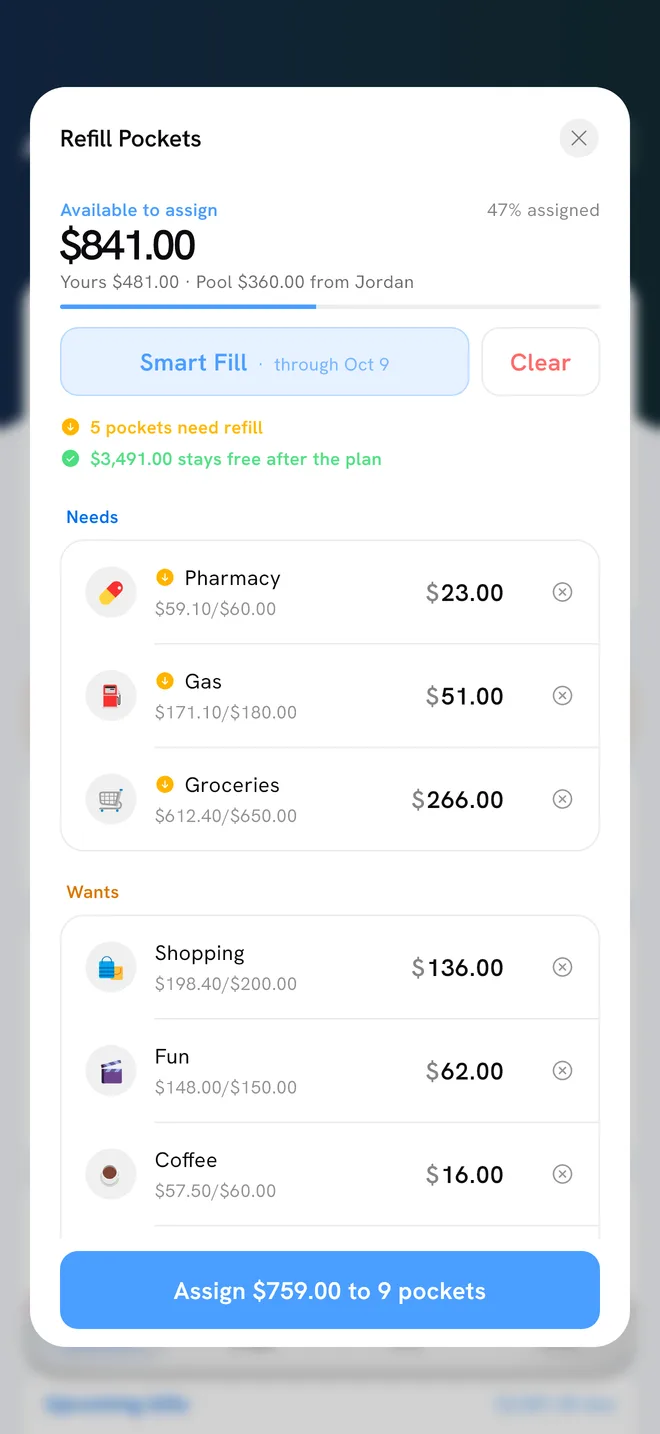
In Aurelo: Smart Fill does this planning for you. It proposes amounts for your pockets through your next payday and covers the bills due before then first, so rent is never competing with groceries for the same dollars. You approve or change every amount before anything is saved.
Cut where it counts, not where it hurts
Small cuts add up, but on a low income there often isn’t much fat to trim. Focus on the few changes that make a real difference:
- Look for recurring charges you’ve forgotten. Old subscriptions and trial memberships are easy to miss when they’re small. Finding every subscription is a quick, one-time job.
- Groceries have the most flexibility of the must-pay costs. Planning meals around what’s on sale and cooking in batches can stretch a food budget further than almost any other change. See how much to spend on groceries for a way to set a realistic number.
- Ask about lower-cost plans. Many phone, internet and utility providers offer reduced-rate plans for lower-income customers. You usually have to ask.
- Stop fees before they start. Late fees, overdraft charges and returned-payment fees take money for nothing. The paycheck plan above is your best protection. Avoiding overdraft fees covers the settings worth checking at your bank.
Build a small buffer, even a tiny one
Having money left at the end of the month is much harder on a small income. In the Federal Reserve’s survey for 2025, 19 percent of adults with income under $25,000 said they always or often had money left over at the end of the month, compared with 59 percent of adults earning $100,000 or more.2 The same survey found that 21 percent of adults with income under $25,000 had set aside enough to cover three months of expenses, against 55 percent of all adults.3
Those numbers aren’t a judgment. They’re a reminder that the usual advice to “save three to six months” can feel out of reach. So start smaller.
- Aim for a first buffer of $100 to $300. That’s enough to absorb a late paycheck, a prescription, or a small car repair without a fee or a new balance on a card.
- Save in small, regular amounts. $5 or $10 from each paycheck counts. The habit matters more than the size at first.
- Keep it separate. A second account, even at the same bank, makes it less likely the buffer quietly becomes grocery money.
- Refill it before growing it. When you use the buffer, and you will, the next goal is to put it back. That’s the buffer doing its job.
Once the first buffer holds, you can think about a larger one. How big should your emergency fund be? shows how to size it from your own essential costs.
In Aurelo: Buffer Days shows how many days your cash would last at your average spending over the last 30 days. Under 14 days shows red. Watching that number move from 5 days to 10 can be more motivating than a dollar target that feels far away.
Check what help you qualify for
Screening for benefits belongs in a low-income budget as much as cutting costs does. Programs exist for food, healthcare, housing, utilities and childcare, and eligibility rules vary more than most people expect. It’s easy to assume you won’t qualify without ever checking.
Two free places to start:
- The USA.gov benefit finder at usa.gov/benefit-finder. It is the U.S. government’s official tool for finding benefits and financial help: you choose categories such as food, health, or housing and utilities, and it points you to programs you may qualify for and how to apply. The older Benefits.gov address now sends you there.
- 211. Calling 211 or visiting 211.org connects you with a local service that knows about help in your area, including rent, utility and food assistance. Calls are confidential.
Be cautious with anyone who charges a fee to “find” benefits for you or asks for bank login details. Official government benefit screening is free.
Make the budget easy to keep
A budget that takes an hour a day won’t last through a hard month. Keep it simple:
- Check in weekly. Ten minutes on the same day each week: what came in, what went out, what’s due before the next paycheck.
- Use three groups. Bills (fixed amounts on a date), Needs (groceries, gas, household basics) and Wants (the small things that make life livable). Wants aren’t a luxury to cut to zero. A small, planned amount keeps a budget from breaking under strain.
- Expect to adjust. A bad month doesn’t mean the budget failed. Move money from one line to another and keep going. Living paycheck to paycheck? has more on reading your numbers when every dollar is spoken for.
How Aurelo can help
Aurelo is a budgeting app for iPhone, currently free in open beta. You can connect your checking account and cards read-only through Plaid, and Aurelo reads your last six months of spending and suggests pockets grouped as Bills, Needs and Wants. Or skip the bank entirely, pick your own pockets, and log spending by hand.
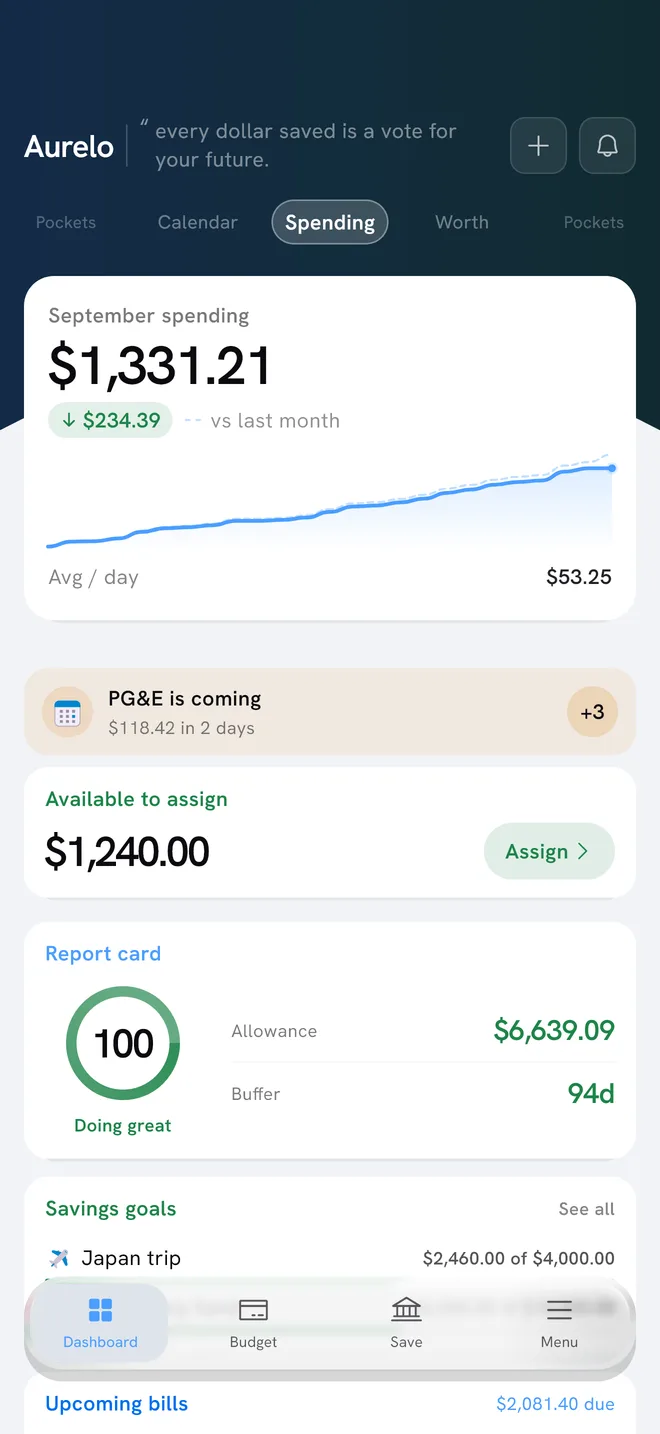
In Aurelo: Today’s Allowance shows what you can spend today: your checking balance, minus the bills due before your next payday, minus what your pockets still need. If it goes negative it turns red and offers a Reshuffle, so you can cover the gap from another pocket before it turns into a fee.
The Free plan includes the full budget, Today’s Allowance, Buffer Days and the Money Calendar, with no card required. Aurelo only reads your accounts. It never moves your money, and it never tells you your situation is your fault.
Common questions
How do you budget when you don't have enough money for everything?
Rank your bills by what happens if they go unpaid. Keep a roof, the lights and water, food, and your way to work first. Then call the creditors lower on the list before the due date to ask about a later date or a payment plan, rather than missing payments silently.
What percentage of a low income should go to rent?
There isn't a percentage that works for everyone on a small income, because the essentials don't shrink with your paycheck. A more useful test is whether rent plus utilities, food and transport fit inside your take-home pay with anything left at all. If they don't, housing is usually the line with the most room to change over time.
Is it worth budgeting if there's nothing left over?
Yes. On a tight income a budget is less about saving and more about timing: knowing which paycheck covers which bill, so you avoid late fees and overdrafts. Those fees are money you keep when the plan works, even if nothing is left at the end.
How do I find out what government help I qualify for?
Start with the benefit finder at USA.gov, which asks about your situation and points you to programs and how to apply. You can also call 211 to reach a local service that knows about help in your area, such as rent, utility and food assistance.
Sources
- Income, Poverty and Health Insurance Coverage in the United States: 2025 , U.S. Census Bureau, 2026
- Economic Well-Being of U.S. Households in 2025: Income and Expenses , Federal Reserve Board, 2026
- Economic Well-Being of U.S. Households in 2025: Savings and Investments , Federal Reserve Board, 2026
Written by the Aurelo team. We build Aurelo, a budgeting app that reads your accounts read-only and never moves your money. Every claim about the app is checked against the app itself, and every figure links to its source. This is general education, not financial, tax or legal advice.