Key takeaways
- The USDA publishes what a nutritious diet costs each month at several price levels, a useful benchmark for your household.
- Your own last three months of receipts are the best starting point; the benchmark tells you whether that number is high, low or typical.
- Budget groceries by the week, since shopping happens weekly and a monthly total is easy to spend early.
- Keep groceries and eating out in separate lines so one can't quietly swallow the other.
Groceries are one of the hardest lines in a budget to get right. They’re a need, they change every week, and prices move. Set the number too high and money leaks into snacks and extras. Set it too low and you’re back at the store on day 20 with nothing left in the line.
There’s no single right answer, but there are two good places to look: what the U.S. Department of Agriculture says a healthy diet costs, and what your own household actually spends. Put those side by side and you can pick a number you can hold.
What the average household spends
Food at home is a steady part of most budgets. In the Bureau of Labor Statistics’ Consumer Expenditure Survey for 2024, the average household spent $6,224 on food at home over the year, about $519 a month, and another $3,945 on food away from home.2 Food at home came to roughly 8 percent of average total spending of $78,535.2
Averages blend single people with large families, so they don’t tell you much about your own number. The USDA’s food plans are more useful for that, because they’re broken down by age and household size.
What the USDA food plans say
Every month, the USDA publishes what it costs to eat a nutritious diet at home at different price levels. The low-cost, moderate-cost and liberal plans differ in the specific foods and quantities, not in nutrition, and all of them assume every meal and snack is prepared at home.1 The USDA also publishes a separate Thrifty plan, its lowest-cost level, which isn’t in this table.
Here are a few monthly figures from the July 2026 report:1
| Person | Low-cost | Moderate-cost | Liberal |
|---|---|---|---|
| Woman, 19–50 | $276.10 | $337.10 | $430.20 |
| Man, 19–50 | $317.40 | $398.70 | $487.50 |
| Child, 6–8 | $262.80 | $305.10 | $357.00 |
| Child, 9–11 | $271.60 | $350.20 | $408.20 |
These figures are for people in four-person households. For other household sizes, the USDA suggests adjusting the total: add 20 percent for one person, 10 percent for two, 5 percent for three, and subtract 5 percent for five or six people.1
Working it out for your household
Add up each person, then apply the adjustment. Here’s how that looks for three common households, using the July 2026 figures:
| Household | Low-cost | Moderate-cost | Liberal |
|---|---|---|---|
| One woman, 19–50 (plus 20%) | $331 | $405 | $516 |
| Couple, both 19–50 (plus 10%) | $653 | $809 | $1,009 |
| Two adults 19–50, children 6–8 and 9–11 | $1,128 | $1,391 | $1,683 |
For example, the couple on the moderate-cost plan: $337.10 plus $398.70 is $735.80, and adding 10 percent for a two-person household gives about $809 a month.
For the family of four, no adjustment applies: $276.10 + $317.40 + $262.80 + $271.60 comes to $1,127.90 on the low-cost plan.
The USDA’s full report lists more ages. Look up each person in your home for a closer figure.
Start with what you actually spend
The benchmark tells you what’s typical. Your receipts tell you what’s real. Before picking a number:
- Pull the last three months of grocery spending from your bank and card statements.
- Include every store, not just the main supermarket: the corner shop, warehouse club runs, the pharmacy trip where you picked up milk.
- Separate food from non-food. If your grocery trips also cover paper towels, cleaning supplies and toiletries, estimate that share. The USDA figures are food only.
- Average the three months. One month can be skewed by a party or a stock-up trip.
Now compare. If your average is close to the moderate-cost figure for your household, you’re in a typical range. If it’s well above the liberal plan, that’s a sign there’s room to trim. If it’s below the low-cost plan, you may already be running lean, and the goal is holding steady rather than cutting further.
How to track your spending walks through pulling these numbers together without it taking all evening.
Set the number and make it weekly
Pick a monthly grocery amount somewhere between your real average and the benchmark you’re aiming for. If you’re trying to bring spending down, move toward the lower figure in steps rather than all at once. A cut that’s too big tends to end with an expensive takeout night.
Then turn it into a weekly figure. Most people shop weekly, and a monthly total is easy to spend early.
Weekly grocery amount = monthly amount ÷ 4.3
Example: A couple sets $780 a month for groceries. That’s about $181 a week. If they spend $200 in week one, they know right away that the next three weeks need to be a little lighter, not in week four when it’s too late to adjust.
Ways to hold the line
A grocery budget is held in small decisions at the store. A few that help most:
- Plan meals around what you have. Check the fridge and cupboards before writing the list. Food that goes bad is money spent twice.
- Shop with a list and a number. Know your weekly amount before you walk in.
- Build meals around the sales. Plan the week’s main dishes after you see what’s discounted, not before.
- Cook in batches. One big pot on Sunday covers several lunches and makes the takeout pull weaker midweek.
- Compare unit prices, not package prices. The shelf tag often shows price per ounce or per count.
- Try store brands for staples. Many are close enough that you won’t notice.
- Keep an eye on the add-ons. Snacks, drinks and a treat at the checkout are small individually and large over a month.
Keep groceries and eating out apart
Groceries and restaurants feel related, and it’s tempting to put them in one “food” line. Keeping them separate works better. When they share a line, a few dinners out can drain the grocery money, and you end up short on basics at the end of the month. With two lines you can see the trade-off clearly: a takeout night comes from the dining line, not from next week’s groceries.
If you share groceries with a partner or housemates, agree on the number together and decide who pays from where. How to budget as a couple covers shared lines without merging everything.
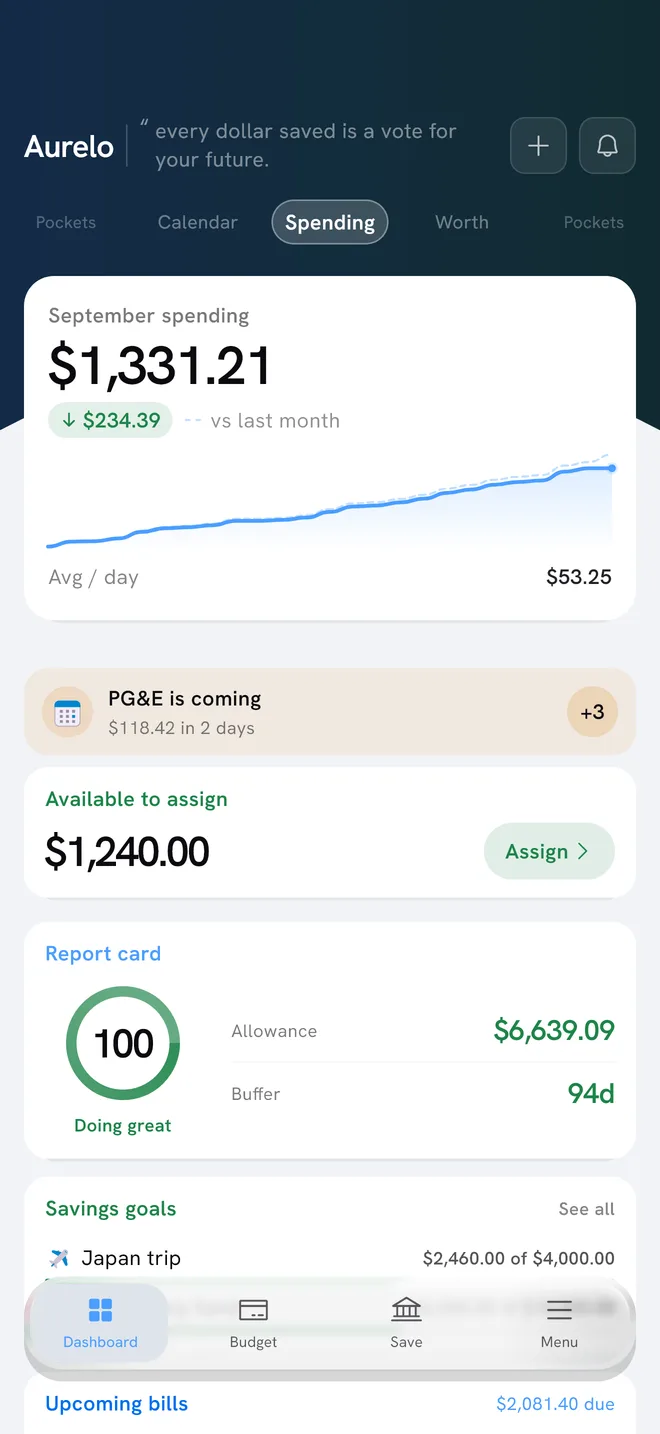
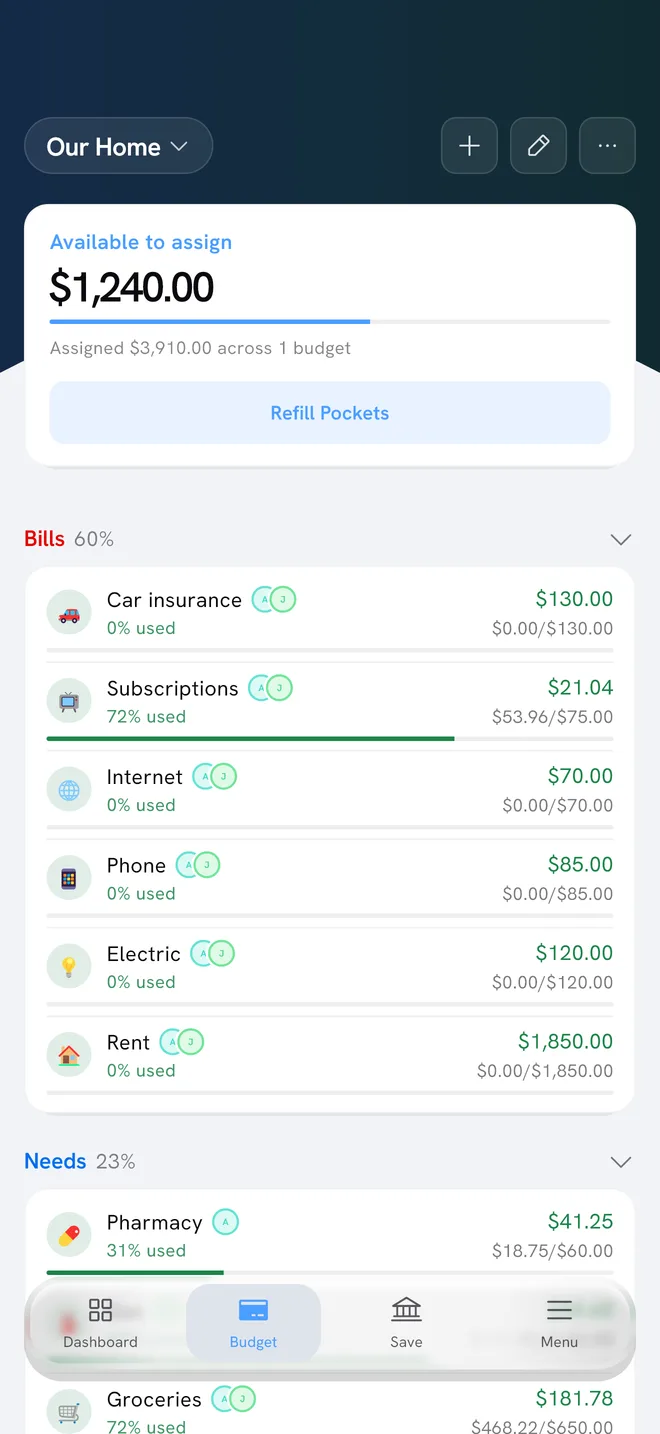
In Aurelo: Your budget is grouped as Bills, Needs and Wants, so groceries can sit in Needs and eating out in Wants. When you connect your bank, Aurelo reads your last six months of spending and suggests a grocery pocket with an amount based on what you really spend there. You can change it to match your target, and refunds are subtracted from spending so a return doesn’t make the month look worse than it was.
When the pocket runs low
It will happen. A guest visits, prices jump, you stock up on something on sale. When the grocery line runs out before the month does:
- Check what’s left in the pantry and freezer before shopping again. A “use it up” week can cover several days.
- Move money from a want to cover it. A smaller eating-out line this month is a fair trade for groceries.
- Adjust next month’s number if it keeps happening. A budget that’s always short isn’t a discipline problem; it’s the wrong number.
In Aurelo: If the grocery pocket runs over, Reshuffle lets you move money from another pocket to cover it, so the rest of your budget still adds up. In a shared budget, everyone on it sees the change the next time they open the app.
For more on picking the other lines in your plan, see budget categories that work, and if food is one of several costs straining a small income, budgeting on a low income covers where to start.
Common questions
What is a reasonable grocery budget for one person?
Using the USDA's July 2026 figures, a woman aged 19 to 50 living alone would spend about $331 a month on the low-cost plan or about $405 on the moderate-cost plan, after the USDA's suggested 20 percent adjustment for a one-person household. Men in the same age group come in higher. Your region, diet and cooking habits will move this.
How much does a family of four spend on groceries a month?
For two adults aged 19 to 50 and two children aged 6 to 8 and 9 to 11, the USDA's July 2026 figures come to about $1,128 a month on the low-cost plan, $1,391 on the moderate-cost plan and $1,683 on the liberal plan. These assume all meals and snacks are made at home.
Do grocery budgets include household items like toilet paper and cleaning supplies?
The USDA food plans cover food only. If you buy paper goods, cleaning supplies and toiletries on the same grocery trip, either raise your grocery line to include them or give them their own household line so you can compare your food spending to the benchmark.
Is it better to budget groceries weekly or monthly?
Weekly usually works better, because that's how most people shop. Divide the monthly amount by about 4.3 to get a weekly figure. It's much easier to notice you're running ahead after one week than after three.
Sources
- Official USDA Food Plans: Cost of Food at Home at Three Levels, U.S. Average, July 2026 , U.S. Department of Agriculture, 2026
- Consumer Expenditures in 2024 , U.S. Bureau of Labor Statistics, 2025
Written by the Aurelo team. We build Aurelo, a budgeting app that reads your accounts read-only and never moves your money. Every claim about the app is checked against the app itself, and every figure links to its source. This is general education, not financial, tax or legal advice.