Key takeaways
- Your savings rate is what you save divided by what you earn, over the same period.
- The U.S. personal saving rate was 3.0 percent in July 2026, so any steady, planned saving puts you ahead of the national figure.
- Common guidance points toward 10 to 20 percent over time, but the right rate depends on your income, costs and goals.
- A rate you can hold every month beats a higher one you abandon after two.
“How much should I be saving?” is one of the most common money questions, and one of the hardest to answer with a single number. A savings rate turns the question into something you can measure: of every dollar that comes in, how much do you keep?
This guide explains how to calculate your own savings rate, what the national figure looks like, how the usual rules of thumb compare, and how to pick a rate you can actually hold. It’s general education, not personal financial advice.
How to calculate your savings rate
Your savings rate is the share of your income you set aside instead of spending.
Savings rate = money saved ÷ income, over the same period
A month is the easiest period to measure. Here’s how to get each number:
- Income. Your take-home pay for the month: what actually landed in your account. (See the gross versus take-home note below.)
- Money saved. Everything you moved to savings, an emergency fund, a goal like a trip or a down payment, or an investment or retirement account you pay into yourself.
- Divide, then multiply by 100 for a percentage.
Example: Your take-home pay is $4,200 in September. You move $300 to your emergency fund and $120 to a vacation goal, and you put $100 into a retirement account you contribute to yourself. You saved $520.
$520 ÷ $4,200 = 0.124, a savings rate of about 12.4 percent.
Gross or take-home?
Both methods are common. Pick one and stick with it.
- Take-home method. Use net pay as income, and count only what you save from it. Easiest to measure from your bank account.
- Gross method. Use pay before taxes and deductions as income, and add any retirement contributions taken directly from your paycheck (plus an employer match if you want to include it) to your savings. This gives a fuller picture when a lot of your saving happens before the money reaches you.
Example, gross method: Gross pay of $5,600 a month. $280 goes to a workplace retirement plan from your paycheck, and you save another $300 from take-home pay. $580 ÷ $5,600 = about 10.4 percent.
The two methods give different numbers for the same person. That’s fine. What matters is comparing like with like over time.
What doesn’t count
- Money you’ll spend soon from a “savings” account. If you park rent money in savings for a week, it isn’t saved.
- Extra debt payments. Paying down a balance improves your finances, but it isn’t savings in this calculation. Many people track it separately, next to their savings rate.
- Growth on existing savings. Interest and investment gains are good news, but savings rate measures what you set aside from income.
What the national figure looks like
The Bureau of Economic Analysis tracks a national personal saving rate: personal saving as a share of disposable personal income, across all households. For July 2026, it was 3.0 percent.1
This is a useful piece of context, but it isn’t a target. The national rate is an aggregate across the whole economy, calculated differently from your own monthly number, and it moves with things like tax changes and spending trends. What it does tell you is that a steady, planned savings rate of even a few percent is not a small thing.
Emergency savings tell a similar story. In the Federal Reserve’s survey for 2025, 55 percent of adults said they had set aside enough in an emergency or rainy day fund to cover three months of expenses.2 In the same survey, 35 percent of non-retirees thought their retirement saving was on track.2 If you feel behind, you have plenty of company, and a clear savings rate is a practical way to start closing the gap.
Common rules of thumb
You’ll see several savings targets suggested. They’re general guidance, not rules, and each assumes things about your situation.
| Guideline | What it suggests | Best fit |
|---|---|---|
| 50/30/20 rule | About 20% of take-home pay to savings and extra debt payments | Steady income with room above the essentials |
| Retirement guidance | Often 10% to 15% of gross income toward retirement over a career | Long-term planning, especially with a workplace plan |
| Starter rate | Any regular amount, even 1% to 5%, while you build the habit | Tight budgets, new budgeters, paying off debt |
The 50/30/20 rule is the most widely quoted. It works when your needs fit inside half your take-home pay. When rent alone takes 40 percent, it can make a reasonable budget look like a failure.
How to pick your own target
A good savings rate is one that fits your life and that you can keep. A few questions help narrow it down:
- Do you have a starter emergency cushion? If not, the first target is a small, fixed amount toward one, even before a percentage. How big should your emergency fund be? walks through sizing it.
- Do you have high-interest debt? Paying it down can be worth as much as saving. You may split what’s available between the two for a while.
- Does your employer match retirement contributions? Many people treat contributing enough to get the full match as a priority, since it adds to what you save.
- What’s left after the essentials? Your rate can only come from money that isn’t already committed. If there’s little left, start small.
- Is your income steady? On a variable income, a percentage of each deposit often works better than a fixed amount. Budgeting on an irregular income covers how.
Then pick a rate, run it for three months, and adjust. If it’s comfortable, raise it by one or two percentage points. If it keeps breaking, lower it. A rate you hold for a year does more than a higher one you drop in February.
Ways to raise your rate over time
- Save first, spend what’s left. Moving money to savings on payday, before other spending, is the idea behind paying yourself first.
- Save part of every raise. When your pay goes up, raise your savings rate by part of the increase before your spending adjusts to the new amount.
- Save found money. Tax refunds, a bonus, the third paycheck in a biweekly month. Deciding in advance keeps it from disappearing.
- Trim one recurring cost and redirect it. A subscription you no longer use becomes a monthly savings amount.
- Watch for lifestyle creep. Spending often rises to meet income. Checking your savings rate each month shows you if it’s slipping.
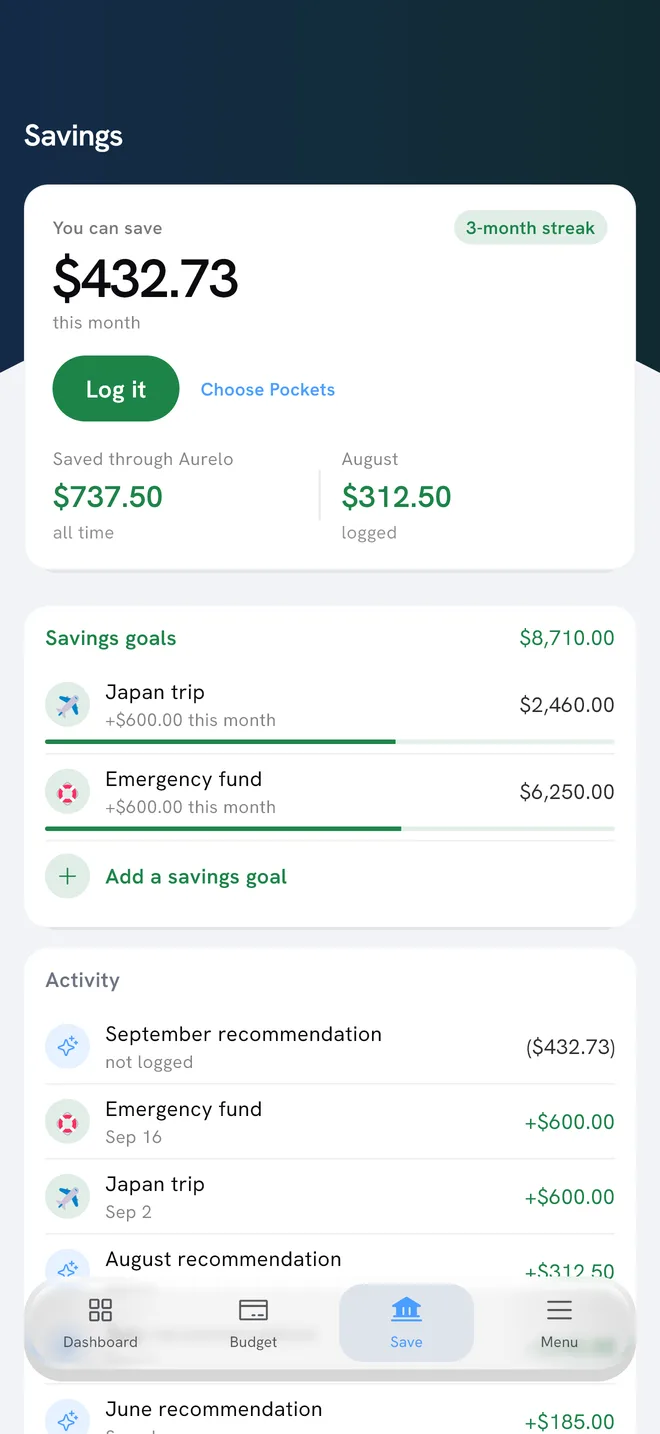
In Aurelo: The Save tab shows “You can save $X this month,” which is what’s left after your pockets and the bills still ahead. You move the money yourself in your own bank, then tap Log it. Aurelo keeps a running total of what you’ve saved and a monthly streak, so you can see whether your rate is holding.
Track it monthly
Your savings rate is most useful as a trend. Once a month:
- Add up what you saved.
- Divide by that month’s income.
- Write it down next to last month’s number.
Over a few months, you’ll see whether you’re steady, climbing or slipping, and you can adjust before a small slip becomes a habit.
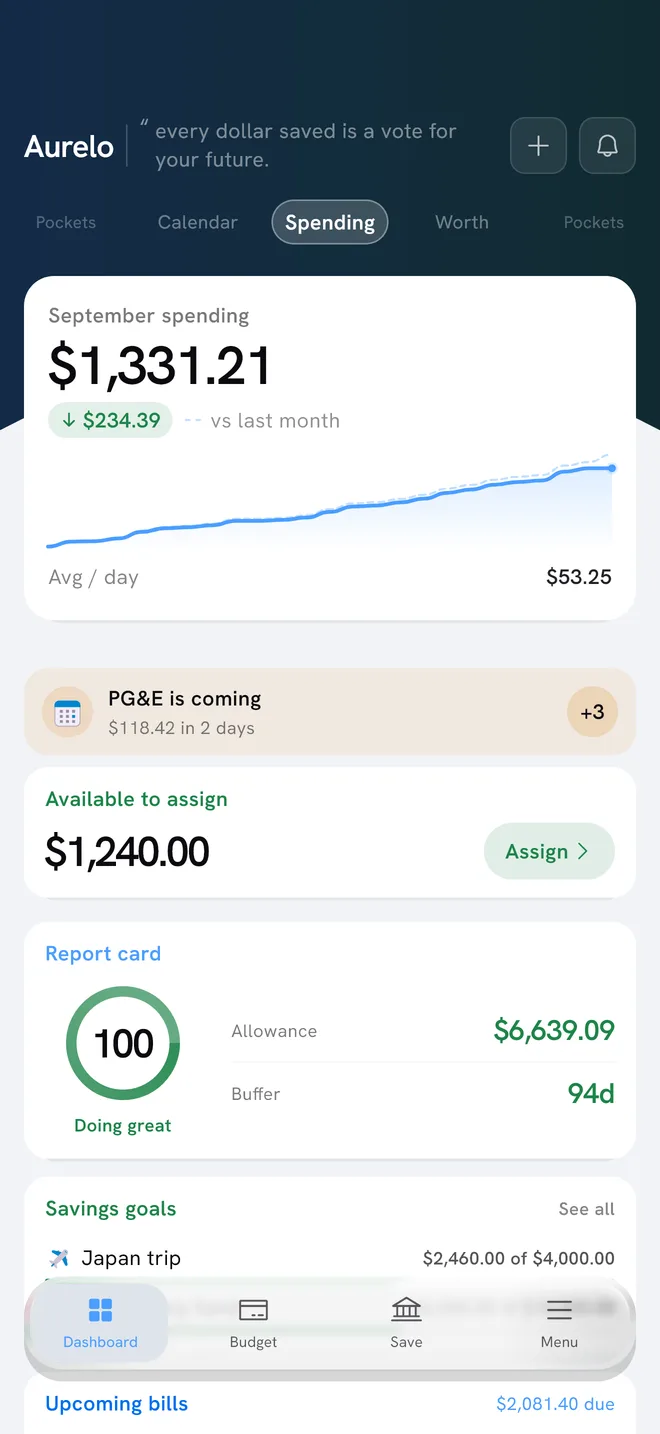
In Aurelo: Savings rate is one of the three parts of the Aurelo Score, alongside Buffer Days and pocket health. The Score sits on the dashboard’s Report card, so you can see your saving next to how your budget is holding up overall.
The short answer
A good savings rate is one you can calculate, hold, and slowly raise. Common guidance points toward 10 to 20 percent over time. If you’re starting from zero, any regular amount is a good first rate, and the national figure of 3.0 percent for July 2026 is a reminder that even a modest, steady rate is worth building.1 Start where you are, measure it every month, and move it up when you can.
Common questions
What is a good savings rate for my age?
There's no official savings rate by age. Common guidance suggests aiming for 10 to 20 percent of income once essentials are covered, often with part of that going to retirement. Starting earlier generally means a lower rate can go further, but any rate you can keep is a good start at any age.
Should I calculate my savings rate from gross or take-home pay?
Either works if you're consistent. Take-home pay is easier to measure from your bank account. Gross pay lets you include retirement contributions taken from your paycheck. Pick one method and use it every month so you can compare.
Does paying off debt count toward my savings rate?
Strictly, no. Savings rate measures money set aside, while debt payments reduce what you owe. Both improve your finances, though, and extra payments on high-interest debt can be worth as much as saving. Some people track the two side by side.
What is the U.S. personal saving rate?
It's the share of disposable personal income that households, taken together, don't spend, as measured by the Bureau of Economic Analysis. It was 3.0 percent in July 2026. It's a national average and a different measure from your own savings rate, so use it as context rather than a target.
Sources
- Personal Income and Outlays, July 2026 , U.S. Bureau of Economic Analysis, 2026
- Economic Well-Being of U.S. Households in 2025: Savings and Investments , Federal Reserve Board, 2026
Written by the Aurelo team. We build Aurelo, a budgeting app that reads your accounts read-only and never moves your money. Every claim about the app is checked against the app itself, and every figure links to its source. This is general education, not financial, tax or legal advice.