Key takeaways
- Lifestyle creep is spending rising to meet income, usually through small upgrades rather than big purchases.
- Decide what a raise is for before the first bigger paycheck lands, not after.
- Splitting each raise, part to enjoy and part to save, beats both spending it all and saving it all.
- Watch fixed costs most closely; a new monthly bill is much harder to undo than a one-off treat.
You get a raise, a promotion or a better-paying job. For a month or two it feels great. Then, somehow, the end of the month looks exactly like it did before. The account balance on the 28th is the same, the savings haven’t really moved, and you’re not sure where the difference went.
That’s lifestyle creep: spending rising quietly to meet a higher income. It’s common, it’s not a character flaw, and it’s easier to manage than it seems once you can see it happening.
How lifestyle creep actually happens
It rarely comes from one big purchase. It comes from dozens of small upgrades that each seem reasonable:
- The grocery trip that now includes the better brand of everything.
- Takeout twice a week instead of once.
- A phone plan, gym or streaming tier one level up.
- A newer car, with a bigger payment and a bigger insurance bill.
- An apartment with an extra room, a better neighborhood, or in-unit laundry.
Each one might be worth it. The problem is that nobody decided the total. The raise gets spent by a series of small defaults rather than one clear choice.
It’s worth knowing how thin the margin already is for many households. The U.S. personal saving rate, which is saving as a share of income after taxes, was 3.0% in July 2026, according to the Bureau of Economic Analysis.1 In other words, across the country, only about three cents of each after-tax dollar was being saved. National averages don’t describe any one person, but they show how easily income and spending move together.
Spending often tracks income
The Bureau of Labor Statistics’ Consumer Expenditure Survey shows the pattern across households. In 2024, average income before taxes rose 2.4% to $104,207, while average annual spending rose 1.8% to $78,535.2 Housing was the only major category with a statistically significant increase, up 3.3%.2
Two things stand out for a household budget. First, spending tends to move with income, even if not one-for-one. Second, the cost that grew most clearly was housing, which is exactly the kind of fixed cost that’s hardest to reverse later.
Why fixed costs matter most
Not all lifestyle creep is equal. There are two kinds of upgrade:
- Flexible upgrades like nicer dinners, a weekend away or new clothes. If money gets tight, you can stop next month.
- Fixed upgrades like a bigger rent, a car payment, a higher insurance tier or a stack of subscriptions. These repeat automatically and usually come with contracts, leases or hassle to undo.
A raise that goes into flexible upgrades is easy to redirect later. A raise that goes into fixed upgrades becomes your new minimum. If your income drops, your costs don’t.
A useful rule of thumb: be generous with one-off treats and slow with new monthly bills. Wait a couple of months into a new income before signing up for anything that repeats.
When a bigger fixed cost does make sense, such as moving closer to work or replacing a car that keeps breaking down, run the numbers against your take-home pay rather than your new salary. Ask how the month would look if the raise disappeared tomorrow. If the answer is “tight but manageable”, the upgrade is probably a choice you can stand behind. If the answer is “we’d be short every month”, it may be worth waiting until your savings have caught up.
Decide what the raise is for before it arrives
The single most effective step is to make the decision before the first bigger paycheck lands. Once the money is sitting in checking, it starts getting spent by habit.
Here’s a simple method:
- Work out the real increase. A raise is quoted before taxes. Look at your first new paycheck or use a paycheck calculator to find the take-home difference per month.
- Split it. Choose a split you can live with. A common one is half to the future (savings or debt) and half to now (your everyday budget).
- Name the “now” half. Decide what you’ll actually enjoy with it. Specific upgrades feel better than vague extra room.
- Move the “later” half first. On payday, move it yourself to savings or toward a debt before you spend anything else. This is the idea behind paying yourself first.
A worked example
Say your take-home pay rises from $3,800 to $4,300 a month, an extra $500. Here’s one possible split:
| Where the extra $500 goes (example) | Monthly |
|---|---|
| Emergency fund, until it reaches its target | $200 |
| Retirement contribution increase or extra debt payment | $50 |
| Eating out, a planned upgrade you’ll enjoy | $120 |
| Gym membership you’ve wanted | $45 |
| Travel fund for one trip a year | $85 |
| Total | $500 |
In this example, half goes to the future, and the other half buys specific things you chose, including one new fixed cost you decided on deliberately. Compare that with letting $500 disappear into slightly bigger grocery, takeout and shopping bills that you’d struggle to point to at the end of the year.
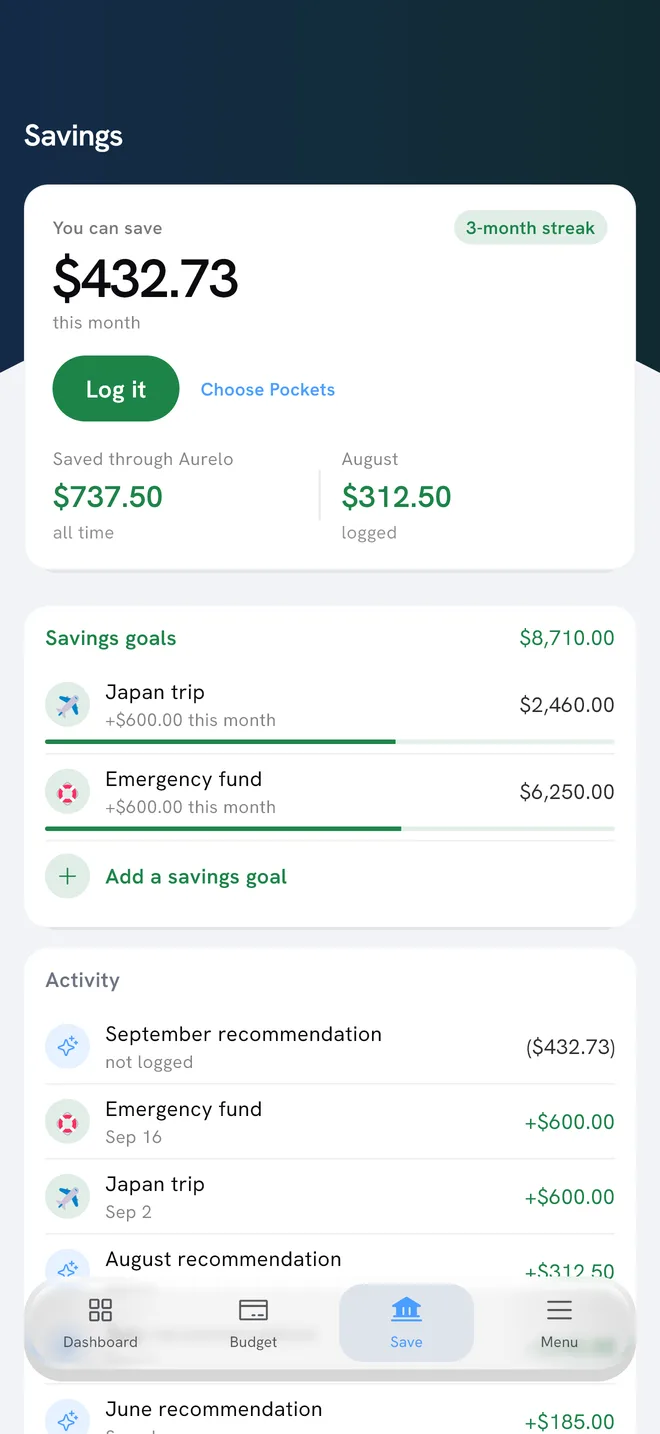
In Aurelo: The Save tab shows “You can save $X this month”, based on what’s left after your pockets and the bills still ahead. After a raise, that number is where the difference shows up. You move the money yourself in your own bank, tap Log it, and Aurelo tracks your running total and monthly streak.
Spot creep early
You don’t need to audit every purchase. A few checks, once a quarter, will catch most of it:
- Savings rate. What share of your take-home pay went to savings or extra debt payments this quarter? If income went up and this stayed flat, the raise went somewhere. What’s a good savings rate? covers how to calculate and judge it.
- Recurring charges. List everything that bills you monthly or yearly. New ones appear quietly.
- Your biggest three flexible areas. Usually groceries, eating out and shopping. Compare with the same month last year.
- Your cushion. Is your emergency fund growing along with your income? The target should grow as your costs do. See how big your emergency fund should be.
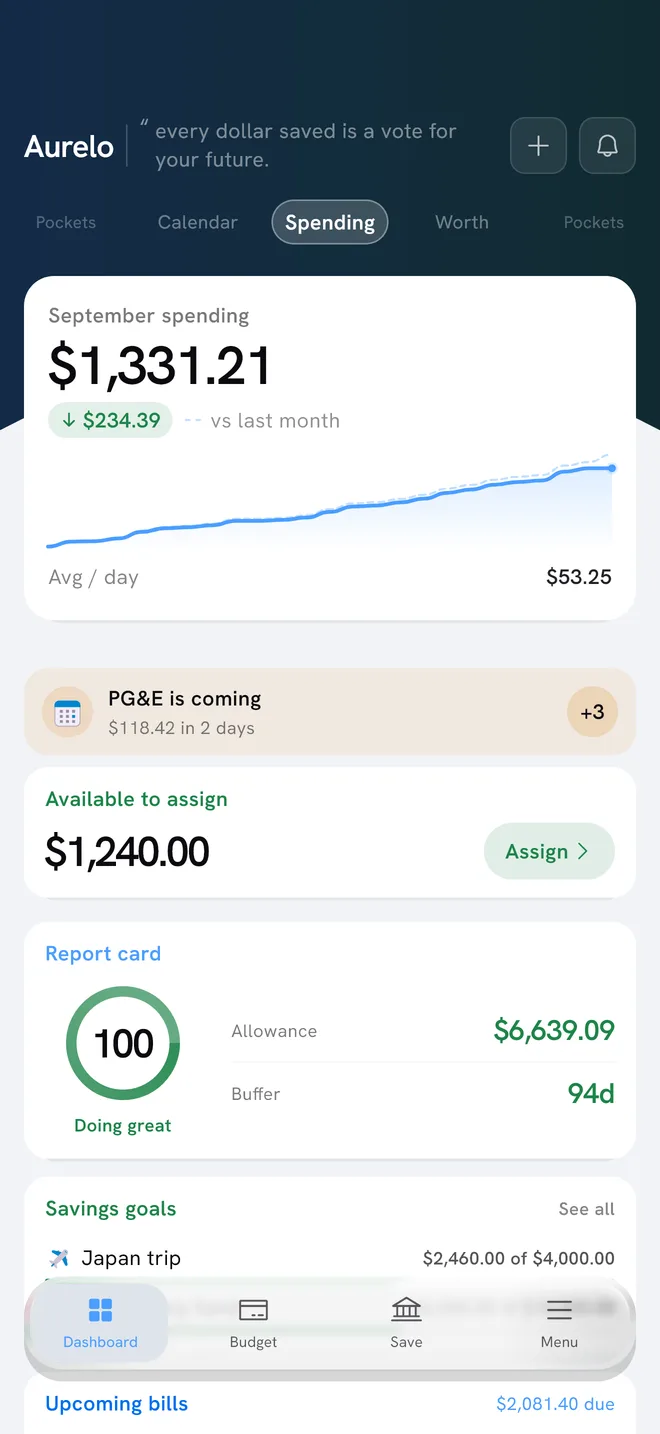
In Aurelo: The Aurelo Score includes your savings rate alongside Buffer Days and pocket health, so a raise that isn’t reaching savings shows up there. Buffer Days measures how many days your cash would last at your recent daily spending, and it falls if spending rises faster than your cash does.
Let your budget grow on purpose
The goal isn’t to live on the same budget forever. A raise should improve your life, and a budget that never allows that tends to get abandoned.
The difference is doing it on purpose. Once a year, or after any change in pay, rebuild your plan from the new take-home number: bills first, then needs, then the wants you actually care about, then savings. If you use a percentage guide like the 50/30/20 rule, remember that it’s a starting point; after a raise, many people choose to hold their spending percentages steady and let the savings share grow.
If you haven’t built a full budget before, how to make a budget walks through it step by step.
The short version
- Lifestyle creep is spending rising to meet income, one small upgrade at a time.
- Before a raise lands, decide how to split it between now and later.
- Move the “later” part first, on payday.
- Be relaxed about one-off treats and cautious about new monthly bills.
- Check your savings rate once a quarter to see whether the raise is actually reaching it.
Common questions
What is lifestyle creep?
It's the gradual rise in everyday spending that follows a rise in income. Nicer groceries, more takeout, a pricier phone plan, a bigger apartment. No single change is dramatic, but together they can absorb most of a raise.
Is lifestyle creep always bad?
No. Spending some of a raise on things that make your life better is reasonable, and it's part of why raises matter. It becomes a problem when it happens by default, leaves savings flat, or locks you into fixed costs that would be hard to cut if income dropped.
How much of a raise should I save?
There's no single right number. A common approach is to split it, for example half to savings or debt and half to your everyday budget. If you're behind on an emergency fund or carrying high-interest debt, you might lean further toward saving for a while.
How do I know if I have lifestyle creep?
Compare your spending and savings now with a year or two ago. If your income is clearly higher but your savings rate is the same or lower, and you can't name what the extra money bought, creep is the likely explanation.
Sources
- Personal Income and Outlays, July 2026 , U.S. Bureau of Economic Analysis, 2026
- Consumer Expenditures in 2024 , U.S. Bureau of Labor Statistics, 2025
Written by the Aurelo team. We build Aurelo, a budgeting app that reads your accounts read-only and never moves your money. Every claim about the app is checked against the app itself, and every figure links to its source. This is general education, not financial, tax or legal advice.