
Key takeaways
- A no-spend challenge pauses optional spending only; bills, groceries and essentials keep going.
- Write your rules and a short list of allowed exceptions before day one, not in the moment.
- Decide in advance where the money you don't spend will go, or it quietly disappears.
- The most useful result is learning which habits you missed and which you didn't.
A no-spend challenge is a short, deliberate break from optional spending. For a set period, often a week or a month, you pay your bills and buy essentials, and skip everything else.
Done well, it can clear a few hundred dollars for a goal and show you exactly where your money usually leaks. Done badly, it’s a miserable few weeks followed by a shopping spree that wipes out the savings. The difference is almost entirely in the setup.
This guide covers how to choose the rules, what usually counts, how to get through the hard days, and how to end the challenge without undoing it.
What a no-spend challenge is (and isn’t)
A no-spend challenge is not a promise to spend nothing. Rent, utilities, insurance, loan payments, groceries, medicine and getting to work all continue. What stops is the optional layer on top: takeout, shopping, paid entertainment and the small purchases that feel like nothing on their own.
That optional layer is often bigger than people expect. In the Bureau of Labor Statistics’ Consumer Expenditure Survey for 2024, the average household spent $3,945 on food away from home and $3,609 on entertainment over the year.1 Your numbers will differ, but even part of that, paused for a month, can add up to real money.
Step 1: Pick a length you can finish
Start shorter than you think you need. A challenge you finish teaches you more than one you abandon on day nine.
- A weekend is a good test run, especially if weekends are when most optional spending happens.
- One week is long enough to break an autopilot habit, like the daily coffee stop.
- One month lines up with bills and paychecks, so it’s easiest to see the effect on your budget.
Put the start and end dates on your calendar. An open-ended challenge tends to end quietly on a bad day without any decision at all.
Step 2: Write your rules before you start
Decide in advance, in writing, what’s allowed. The point is to make every choice once, when you’re calm, instead of fifty times at a checkout.
A simple rule set might look like this:
| Allowed | Paused |
|---|---|
| Rent, utilities, phone, insurance | Eating out and takeout |
| Loan and card payments | Coffee shops |
| Groceries, up to $125 a week (example) | Clothes, shoes, accessories |
| Gas and transit to work | Home decor and gadgets |
| Medicine and health costs | New subscriptions or apps |
| One planned social event | Paid streaming add-ons and in-app purchases |
Two tips while you write it:
- Allow a few named exceptions. A friend’s birthday dinner or a work lunch you can’t skip. Naming them ahead of time keeps them from becoming loopholes.
- Handle gifts and replacements. If something essential breaks, you replace it. If a birthday falls in the month, set the gift amount now.
Step 3: Get ready before day one
A little preparation removes most of the temptation.
- Stock the kitchen. Plan a week of meals from what you already have plus a normal grocery trip. Hunger at 7pm is where takeout wins.
- Log out and unsubscribe. Remove saved cards from shopping sites and unsubscribe from sale emails for the month.
- Check for renewals. An annual subscription renewing mid-challenge isn’t a failure, but it’s better to know. Finding every subscription walks through how to spot them.
- Tell the people you spend with. Suggest free plans instead: a walk, a potluck, a library visit, a game night at home.
Step 4: Decide where the money goes
This is the step people skip, and it’s the one that makes the challenge worth doing. Money you don’t spend doesn’t automatically become savings. It sits in checking and gets absorbed by next month.
Pick a destination before you start and move the money there yourself:
- An emergency cushion. In the Federal Reserve’s 2025 survey, 63% of adults said they would cover a $400 emergency expense with cash or its equivalent.2 If you’re in the other group, a no-spend month is a fast way to build a first cushion. See how big your emergency fund should be.
- A card balance. Extra toward a high-interest card goes a long way.
- A specific goal like a trip or a deposit.
A practical way to do it: at the end of each week, add up what you would normally have spent on the paused areas and move that amount.
In Aurelo: The Save tab shows “You can save $X this month”, which is what’s left after your pockets and the bills still ahead. You move the money yourself in your own bank, then tap Log it, and Aurelo keeps a running total and a monthly streak.
Step 5: Get through the hard days
Most challenges wobble in the second week, when the novelty wears off. A few things that help:
- Keep a wish list. When you want something, write it down with the date instead of buying it. Many items look much less necessary a month later.
- Notice the trigger. Boredom, stress, a long day, a sale notification. You don’t have to fix it during the challenge, just see it.- Don’t restart from zero after a slip. One takeout order doesn’t end the month. Note it, move on, and keep going.
Step 6: End it without a rebound
The rebound splurge is the most common way a no-spend challenge backfires. After weeks of saying no, the first free weekend turns into several weeks’ worth of spending at once.
To avoid it:
- Plan the first week back before the challenge ends. Decide one or two things you’ll enjoy, and what they’ll cost.
- Give the paused areas a real budget. If eating out was $400 a month before, maybe it’s $250 now. A limit you chose beats no limit.
- Review the wish list. Buy what still seems worth it, within your plan, and cross off the rest.
- Keep what was easy. If you didn’t miss the coffee shop, don’t bring it back just because you can.
What to look at when it’s over
The savings are nice, but the most useful part of a no-spend challenge is the information. Afterwards, compare the month with a normal one:
- Which paused areas did you barely miss? Those are candidates for smaller budgets.
- Which ones did you really miss? Those probably deserve a steady, planned amount instead of guilt.
- Did spending move somewhere else, like more groceries or more online “essentials”?
This is where tracking your spending pays off. You can only compare months if you can see them side by side.
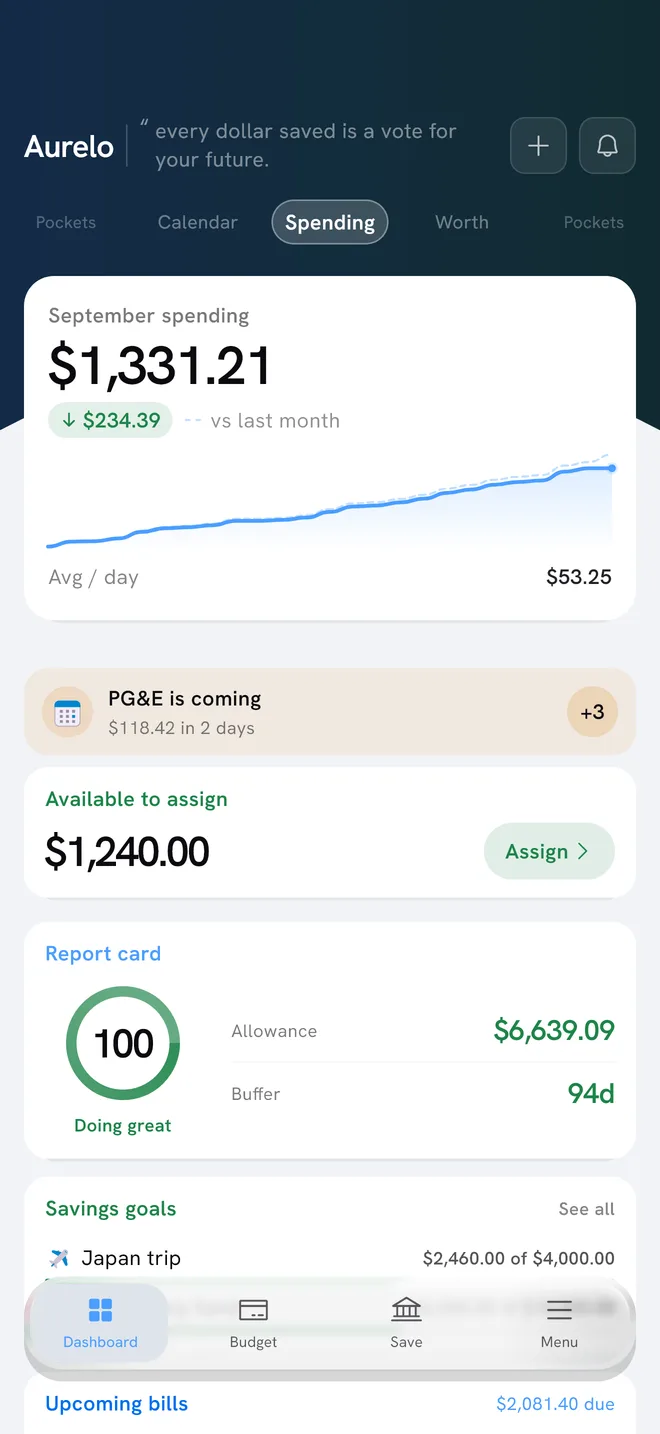
In Aurelo: Your dashboard shows this month’s spending against last month, and each pocket shows what’s left: what you put in, minus what you’ve spent. The Monthly recap looks back at what came in, what went out and how each pocket did, which makes the before-and-after easy to see.
When a no-spend challenge isn’t the right tool
If money is tight because your fixed costs are higher than your income, pausing takeout won’t close the gap, and a challenge can feel like failure when it isn’t. In that case, start with a full picture of where the money goes and which costs you can change; living paycheck to paycheck is a better starting point.
And if you find yourself doing back-to-back challenges because normal months keep going over, the problem is usually the budget, not your willpower. A plan with realistic amounts for the things you enjoy tends to hold better than repeated all-or-nothing months. See how to stop overspending.
The short version
- Choose a length you can finish.
- Write what’s allowed and what’s paused, with a few named exceptions.
- Prepare the kitchen, your inbox and the people around you.
- Pick where the unspent money goes and move it weekly.
- Plan the week after, so the challenge ends in a budget, not a splurge.
- Keep the habits you didn’t miss.
Common questions
What is not allowed during a no-spend challenge?
Usually anything optional: eating out, takeout, coffee runs, shopping for clothes or gadgets, new subscriptions and paid entertainment. You set the exact list, and it helps to write it down before you start so there's nothing to argue with yourself about later.
How long should a no-spend challenge last?
A weekend or a single week is a good first try. Many people then move to a full month once they know which rules are realistic. Longer is not automatically better; the goal is a reset, not a test of endurance.
Can you buy groceries on a no-spend challenge?
Yes. Most versions allow groceries, often with a set weekly amount and a rule to use up what's already in the cupboard first. Cutting food entirely just pushes the spending into takeout later.
How do I avoid overspending after a no-spend month?
Plan the first week after the challenge before it ends, give yourself a small planned treat instead of an open-ended one, and keep one or two of the habits that felt easy. A modest, specific budget for the areas you paused is the best guard against a splurge.
Sources
- Consumer Expenditures in 2024 , U.S. Bureau of Labor Statistics, 2025
- Economic Well-Being of U.S. Households in 2025: Savings and Investments , Federal Reserve Board, 2026
Written by the Aurelo team. We build Aurelo, a budgeting app that reads your accounts read-only and never moves your money. Every claim about the app is checked against the app itself, and every figure links to its source. This is general education, not financial, tax or legal advice.